
A proforma invoice is a preliminary document sent before goods are shipped. It works as a formal quote outlining price, quantity, and terms. A commercial invoice is issued after shipment and is the legally binding document customs authorities use to calculate duties and clear your cargo. Both are required at different stages of the same export transaction. Using one in place of the other, or getting the details wrong on either, causes delays that are entirely avoidable.
Of all the document confusion that costs exporters time and money, the proforma invoice versus commercial invoice question comes up more consistently than almost any other. They look almost identical. They contain much of the same information. And yet they serve completely different purposes in the export process, are used at different stages, and have very different legal standing.
Submitting a proforma when customs needs a commercial invoice can hold your shipment. Issuing a commercial invoice before terms are finalised locks in details that may still need to change. And if the details on your proforma do not match the commercial invoice you eventually send, you are looking at a Letter of Credit discrepancy that puts payment at risk.
This guide covers both documents clearly, explains when each one is issued and why, and walks through exactly what needs to be on each one for international trade compliance.
For a broader view of all the documents your shipment requires, see our complete guide to documents required for international export.
What Is a Proforma Invoice?
A proforma invoice is a quote prepared by the exporter that closely resembles a commercial invoice. An international sale often begins with a letter of inquiry from a potential buyer expressing interest in one or more of your products, and a buyer may request a quote in the form of a proforma invoice in order to arrange a letter of credit to pay for the goods or to secure financing for the purchase.
In plain terms, a proforma invoice is the exporter's formal offer. It says: here is what we are selling, here is the price, here are the terms under which we will ship. The buyer uses it to decide whether to proceed, to arrange financing, or to apply for an import permit in their country.
A proforma invoice is not the same as a commercial invoice. A proforma invoice is a preliminary document that states the offer from the seller to provide specific products at a given price. It functions as a preliminary document that lists the particulars and anticipated charges of a proposed transaction. It is essentially a good-faith estimate of the final commercial invoice. It is not legally binding, meaning it cannot be used to demand payment or enforce the terms of the sale.
The word proforma comes from Latin, meaning "for the sake of form," which is a reasonable description of its purpose. It gives the transaction a formal structure before anything is finalised.
When a proforma invoice is used:
Before the buyer places a confirmed purchase order, to give them the information they need to evaluate the transaction.
When a buyer needs to open a Letter of Credit with their bank, who requires a proforma to set the LC terms.
When a buyer needs to apply for an import permit or foreign exchange approval in their country.
When an exporter is quoting for a custom or made-to-order product where the final specifications may still be confirmed.
Certain countries may require a proforma invoice if they tightly control their currency exchange rate, require import permits, or use import quotas to protect local industries.
What should be on a proforma invoice:
The words "Proforma Invoice" clearly stated in the header, so the buyer knows this is not a demand for payment.
Seller and buyer details: full names, addresses, and contact information.
A detailed description of the goods, including quantity, unit price, and total value.
The currency of the transaction.
Incoterms and the named location, for example FOB Mumbai, Incoterms 2020. For a detailed explanation of what each Incoterm means for your shipment costs and risk, see our guide to Incoterms explained: what FOB, CIF, and EXW actually mean for your shipment.
Link: https://freightnaut.com/blog-detail/incoterms-explained-fob-cif-exw-meaning-export-shipment
Payment terms and the method of payment.
Estimated shipment date and port of loading.
A common mistake with proforma invoices is neglecting key terms and conditions like payment deadlines, accepted payment methods, and validity periods. If you do not specify that the proforma invoice is only valid for 30 days, the buyer might assume the quoted price is fixed indefinitely.
Validity period of the proforma, typically 30 to 60 days, depending on price stability and production lead times.
HS codes where the buyer needs them for import duty estimation.
What Is a Commercial Invoice?
Unlike the proforma invoice, a commercial invoice is a legally binding document that serves as a record of the finalized sale agreement between the seller and the buyer. It is a crucial document that is required for customs clearance purposes and is an essential part of the international trade process.
The commercial invoice is issued after goods are shipped or ready for shipment. It is the document that formalises the completed transaction and gives customs authorities everything they need to assess duties, verify cargo, and release the goods at the destination.
The commercial invoice is the primary shipping document used by customs authorities worldwide for commodity control and valuation. Banks processing Letters of Credit rely on it to verify that the terms of the LC have been met. Your freight forwarder uses it to complete export filings. Customs at the destination port uses it to calculate import duties and taxes.
Using a proforma invoice when a commercial invoice is required in international trade can delay customs and potentially hold up your shipment. Failure to provide commercial invoices may result in hold-ups, shipping delay costs, or legal ramifications from tax authorities.
When a commercial invoice is issued:
When goods are ready to ship or have been shipped.
When a buyer's bank needs to release payment under a Letter of Credit.
When customs at the destination port needs to assess duties and clear the cargo.
When the buyer needs documentation for import accounting and tax records.
A proforma invoice can be presented to customs authorities when importing goods to the US. However, the commercial invoice is still required and must be provided within 120 days.
What must be on a commercial invoice:
The words "Commercial Invoice" in the header.
A unique invoice number and the date of issue.
Seller and buyer details: full legal names, addresses, and contact information.
A complete description of the goods: product name, specifications, HS code, quantity, unit price, and total value. Every word in this description must match your packing list exactly.
Currency of the transaction.
Incoterms and named location.
Country of origin of the goods.
Total invoice value and the currency.
Payment terms.
Port of loading and port of discharge.
Any additional information required for the specific destination country or product category.
Accurately filling out the commercial invoice is imperative to get your shipment on time and avoid long shipping delays. Putting inaccurate information could result in you paying the wrong duty rate, meaning you could be overpaying or underpaying the duty on your import.
Proforma Invoice vs Commercial Invoice: The Key Differences Side by Side
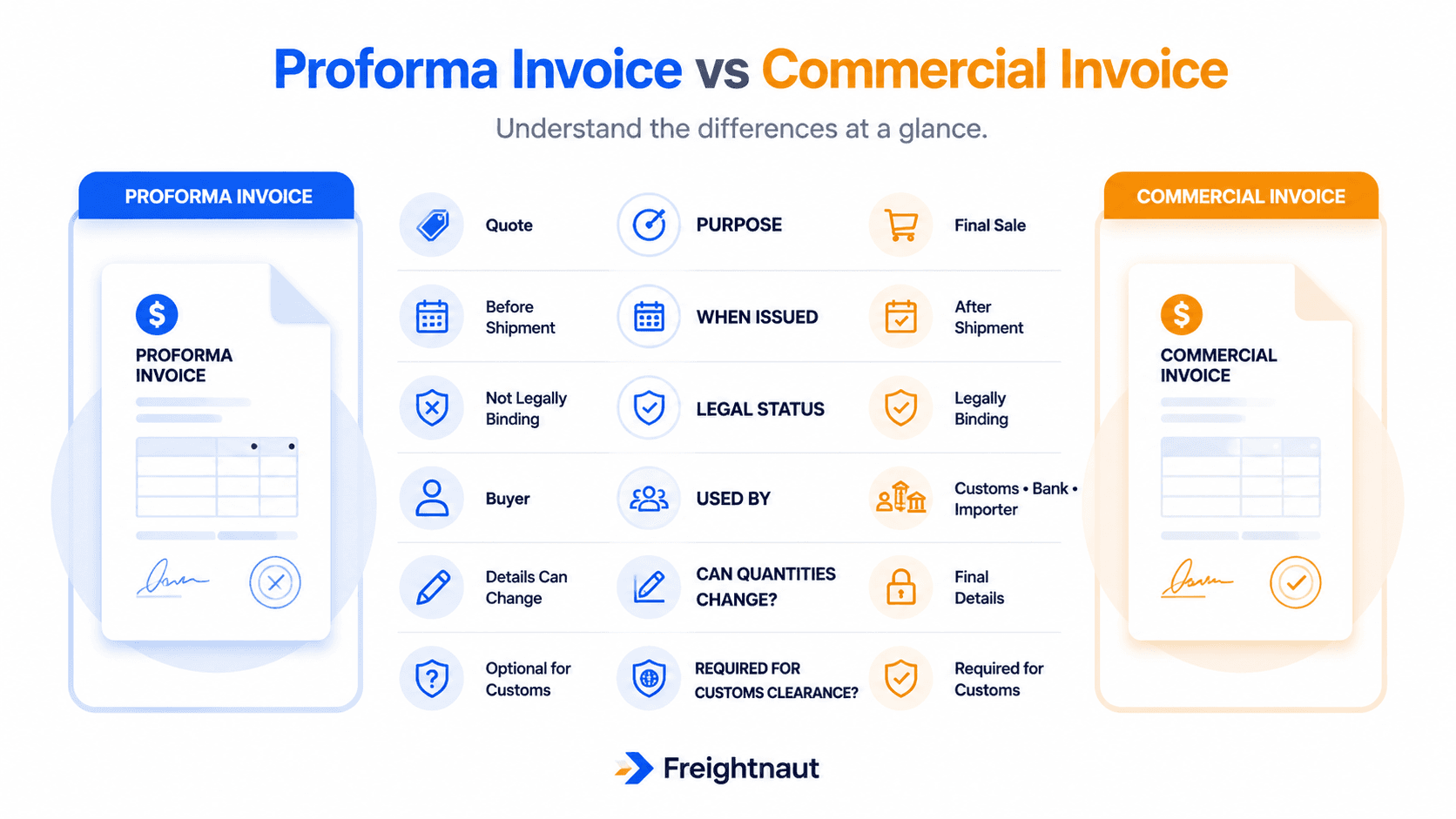
Purpose Proforma Invoice: A formal quote sent before the transaction is confirmed. Commercial Invoice: A legally binding record of a completed sale used for customs clearance and payment.
When it is issued Proforma Invoice: Before goods are shipped, often before the buyer has placed a confirmed order. Commercial Invoice: After goods are shipped or ready for shipment.
Legal status Proforma Invoice: Not legally binding. Cannot be used to demand payment. Commercial Invoice: Legally binding. Used by customs authorities, banks, and importers.
Used by Proforma Invoice: The buyer, to arrange financing, import permits, or Letters of Credit. Commercial Invoice: Customs at origin and destination, freight forwarders, banks, and importers.
Can quantities change after issue? Proforma Invoice: Yes. The proforma is an estimate and terms can still be negotiated. Commercial Invoice: No. The commercial invoice should represent the final, agreed-upon details of the transaction including any necessary additional export or import control information.
Required for customs clearance? Proforma Invoice: Not typically required by customs, though some countries accept it provisionally. Commercial Invoice: Mandatory for customs clearance in virtually every country.
The Critical Rule: Your Proforma and Commercial Invoice Must Match
This is where many exporters create problems for themselves. A buyer receives a proforma, uses it to open a Letter of Credit, and the LC is structured around the exact wording, quantities, and values on that proforma. When the commercial invoice is then issued with slightly different wording, a different unit price after a discount was applied, or a product description that was abbreviated, the LC presentation fails on discrepancy.
Ensure your final invoice matches the proforma invoice. You do not want to tell customers one thing and then deliver something different. This breaches trust and can cause disputes, so always double-check to prevent discrepancies.
The principle is simple. Whatever you write on the proforma is what the buyer's bank, their customs authority, and their import system expect to see on the commercial invoice. If anything changes between the two, both parties need to agree on the change and the LC may need to be amended before shipment.
Quantity can legitimately differ between proforma and commercial invoice, particularly in commodity trades where the exact volume is only confirmed at the time of loading. The quantity of products ordered from the proforma invoice is often different to the actual quantity of goods shipped on the commercial invoice. This is common in global trade and can be due to manufacturing issues or the supplier not correctly planning how many products would fit inside shipping containers. Any expected difference should be communicated to the buyer before shipment so the LC and import documents can accommodate it.
How Proforma and Commercial Invoices Connect to Letters of Credit
If your buyer is paying through a Letter of Credit, understanding how both invoices interact with the LC is essential.
The proforma invoice is where the LC process begins. The buyer takes your proforma to their bank, and the bank issues an LC based on the terms stated on it. The LC will specify exactly what documents you need to present, in what format, and by what deadline, to receive payment.
When you are ready to ship, you issue a commercial invoice. That commercial invoice must match the LC terms precisely. The product description, quantity, value, Incoterms, and any other fields specified in the LC must appear on your commercial invoice exactly as the LC states.
In Letters of Credit transactions, the commercial invoice is presented to the issuing bank to facilitate payment. It provides a comprehensive and official record of the transaction, aiding in importation processes.
A mismatch between your commercial invoice and the LC terms creates a discrepancy. The bank can refuse to pay against a discrepant LC presentation until the discrepancy is resolved or accepted by the buyer. This is one of the most common and costly errors in export finance, and it almost always starts with a proforma invoice that was not carefully carried forward into the commercial invoice.
Common Mistakes Exporters Make With Both Documents
Sending the proforma too late. A proforma invoice should be valid for a specific period. Because you are often quoting both the product cost and transportation costs, it is important to give the buyer a reasonable amount of time to respond. If the buyer needs the proforma to open an LC and you send it after they have already started the process informally, the LC may be structured around assumptions that do not match your actual terms.
Using the same document for both purposes. Some exporters issue a single invoice document and simply update it. This creates version confusion, particularly when the LC has been issued against an earlier version and the "updated" document no longer matches what the bank is holding.
Leaving out the Incoterm. Both the proforma and the commercial invoice must state the Incoterm and the named location. A price without an Incoterm is ambiguous because it does not tell the buyer whether freight and insurance are included or excluded. For a full explanation of how Incoterms affect your export pricing and risk, see our guide to Incoterms explained: what FOB, CIF, and EXW actually mean for your shipment.
Link: https://freightnaut.com/blog-detail/incoterms-explained-fob-cif-exw-meaning-export-shipment
Inconsistent product descriptions across documents. The product description on your commercial invoice must match your packing list word for word. A product described as "Stainless Steel Pipes, Grade 304" on the invoice and "SS Pipes 304" on the packing list may look the same to you. To an automated customs verification system, they are two different entries. For a detailed breakdown of how document mismatch causes customs delays, see our complete guide to documents required for international export.
Link: https://freightnaut.com/blog-detail/documents-required-for-international-export-the-complete-checklist-for-first-time-exporters
Not including all required fields for the destination country. Customs requirements vary by destination. Some markets require additional fields on the commercial invoice such as the buyer's tax identification number, a specific country of origin declaration format, or a declaration of compliance with local regulations. Check the specific requirements of your destination market before issuing the commercial invoice.
How Freightnaut Handles Both Documents
Freightnaut generates both the proforma invoice and the commercial invoice from the same shipment record. Product descriptions, HS codes, buyer and seller details, quantities, and pricing are entered once and populated consistently across both documents.
When you are ready to convert a proforma into a commercial invoice, the data carries across without re-entry, eliminating the mismatch risk that creates LC discrepancies and customs queries. Both documents are stored centrally with version control, so there is never any confusion about which version was sent, which one the buyer's bank is holding, or whether the commercial invoice matches the proforma the buyer used to open their LC.
Frequently Asked Questions
Q. What is the difference between a proforma invoice and a commercial invoice?
A. A proforma invoice is a preliminary document sent before goods are shipped. It acts as a formal quote that outlines the terms of the proposed sale. A commercial invoice is issued after shipment and is the legally binding document used by customs authorities to assess duties and clear cargo. Both contain similar information but serve entirely different purposes at different stages of the export process.
Q. Is a proforma invoice legally binding?
A. No. A proforma invoice is not legally binding. It cannot be used to demand payment from a buyer. It is an estimate and a formal quote, not a contract. The commercial invoice is the legally binding document that records the finalised transaction.
Q. Can a proforma invoice be used for customs clearance?
A. In most cases, customs requires a commercial invoice for clearance. A proforma invoice can be used provisionally in some markets, but the commercial invoice must follow. In the United States, for example, a proforma invoice may be accepted temporarily, but the commercial invoice must be provided within 120 days.
Q. When should I issue a proforma invoice?
A. Issue a proforma invoice when a buyer requests a formal quote, when they need documentation to open a Letter of Credit, when they need to apply for an import permit, or when you are quoting for a custom order where the final specifications are still being confirmed.
Q. When should I issue a commercial invoice?
A. Issue a commercial invoice when the goods are ready to ship or have been shipped, and all terms of the transaction have been finalised and agreed by both parties.
Q. Does the proforma invoice have to match the commercial invoice?
A. Yes, as closely as possible. Any field that was used to structure a Letter of Credit must match exactly. Differences in product description, value, Incoterms, or any other LC-specified field will create a discrepancy that can delay payment. Communicate any unavoidable changes to your buyer before shipment so the LC can be amended if necessary.
Q. What happens if I send a commercial invoice instead of a proforma?
A. If a buyer asked for a proforma and you send a commercial invoice, you are effectively issuing a demand for payment before the buyer has confirmed the order. This can create confusion, payment disputes, and trust issues. It also creates accounting and tax complications, because a commercial invoice represents a completed sale in most accounting systems.
Q. Do both invoices need to show the Incoterm?
A. Yes. Both documents should state the Incoterm and the named location. The Incoterm defines who is responsible for freight, insurance, and risk at each stage of the shipment. Without it, the price on your invoice has no clear meaning in terms of what is and is not included.