
Every international shipment needs a core set of documents regardless of which country you are exporting from. A commercial invoice, a packing list, a certificate of origin, a bill of lading or airway bill, and proof of payment terms form the universal foundation. On top of that, most countries add their own filing requirements, the US requires an EEI filing through AES, the UAE requires a Mirsal 2 declaration, India requires a Shipping Bill filed through ICEGATE, and the UK and EU require an EORI number.
If you are preparing your first export shipment, that sentence probably raised more questions than it answered. That is exactly what this guide is for.
Most first-time exporters learn this the hard way. A shipment gets held at the destination port because one document was missing. A buyer's bank rejects a Letter of Credit presentation because a name did not match exactly. A container sits at the origin port because a country-specific filing was never submitted. None of these are rare. They are the single most common reason new exporters lose time, money, and buyer trust in their first six months of shipping internationally.
This guide breaks the document requirement into two layers. The universal documents every shipment needs, and the country-specific filings that depend on where you are exporting from and where you are exporting to.
The Universal Documents Every International Shipment Needs
These documents apply regardless of origin or destination country. If you are exporting internationally, you need all of them in some form.
1. Proforma Invoice
A proforma invoice is the preliminary offer you send to a buyer before goods are shipped. It sets out the product description, quantity, price, Incoterms, and payment terms. It is not a demand for payment, but it is often required to open a Letter of Credit or secure import approval on the buyer's side. Buyer confirmation of the proforma invoice becomes the foundation for every document that follows, so it pays to get it right the first time rather than revising it after the commercial invoice is already drafted.
2. Commercial Invoice
The commercial invoice is the primary document customs authorities use to assess duties and value the shipment. It needs to match the packing list and the shipping documents word for word on product description, quantity, and value. A surprisingly large share of customs delays trace back to a commercial invoice that uses slightly different wording than the packing list for the same product.
3. Export Packing List
The packing list details exactly what is in each box, crate, or pallet. Item by item, weight by weight, dimension by dimension. Customs officials use it to verify cargo without opening every package. Your freight forwarder and your cargo insurer also rely on it for any transit damage claim, so an incomplete packing list is not just a customs risk, it can also leave you without a recourse if something goes wrong in transit.
4. Certificate of Origin
A certificate of origin verifies the country where goods were manufactured or produced. It matters for two reasons. Customs authorities use it to determine applicable tariffs, and many trade agreements offer reduced duty rates if the certificate proves the goods qualify under that agreement. The issuing authority varies by country. In India it is typically a Chamber of Commerce or DGFT. In the UAE it is issued through Dubai Chambers or the relevant emirate's chamber. In most markets it can be either non-preferential, for general customs purposes, or preferential, to claim reduced duty under a specific trade agreement.
5. Bill of Lading or Airway Bill
Issued by the shipping line or airline, this is the contract of carriage and proof of shipment. For sea freight, the Bill of Lading is also a negotiable document of title, meaning your buyer cannot collect the goods at the destination port without the original document in hand. Every detail on it, vessel name, port of loading, port of discharge, container number, needs to match exactly across your invoice and packing list.
6. Letter of Credit or Payment Terms Documentation
If payment is secured through a Letter of Credit, the LC terms govern what documents must be presented, in what format, and by what deadline. According to the International Chamber of Commerce, more than 70 percent of LC presentations contain at least one discrepancy on first submission. Reading the LC line by line before booking the shipment, not after the goods are packed, is the single highest leverage habit a first-time exporter can build.
7. Insurance Certificate
If shipping under CIF terms, Cost, Insurance, and Freight, the exporter is responsible for arranging cargo insurance and providing the certificate to the buyer. The policy needs to cover the full value of the shipment, and for certain categories of goods, standard marine cover may not be sufficient.
8. VGM Document
Under SOLAS regulations, every packed container shipped by sea requires a Verified Gross Mass declaration before it can be loaded onto a vessel. This applies internationally, not to any single country. A missing or incorrect VGM submission means the container does not get loaded, regardless of how complete every other document is.
Documents That Vary By Country
This is where most first-time exporters get caught off guard. The universal documents above are necessary everywhere, but they are not sufficient. Every country layers its own filing system, registration requirements, and customs declaration process on top of them.
Country or Region | Filing System | What It Requires |
India | ICEGATE | Shipping Bill filed electronically, AD Code registration, IEC, and an 8-digit ITC-HS Code on every line item |
United States | AES (Automated Export System) | Electronic Export Information filing required when a single Schedule B commodity value exceeds USD 2,500, or when an export license applies regardless of value |
United Kingdom and European Union | EORI Number | Economic Operators Registration and Identification number required on the commercial invoice and customs declaration for nearly all commercial shipments |
United Arab Emirates | Mirsal 2 / Dubai Trade Portal | Export declaration filed electronically, exporter must hold an active trade licence and be registered with the Federal Customs Authority |
If you are exporting from India specifically, the ICEGATE filing process, the Shipping Bill types, and the most common reasons documents get rejected at Indian customs are covered in detail in our guide on why export documents keep getting rejected at Indian customs and exactly how to fix it.
Documents That Depend on What You Are Shipping
Beyond the universal and country-specific layers, certain product categories carry their own documentation requirements.
Food and agricultural products typically require a phytosanitary certificate, a health or sanitary certificate, and in some markets, country-specific food safety compliance documentation. These certificates are often time-sensitive and shipment-specific, meaning a certificate from a previous shipment cannot simply be reused.
Engineering and industrial goods often require inspection certificates, technical compliance documents such as CE marking or material test certificates, and in some cases an export license if the product falls under dual-use or controlled technology classifications. If you manufacture and export engineering goods, our complete engineering export documentation guide for manufacturers and exporters covers the full eighteen-document checklist specific to this category, including SCOMET clearance and EEPC India registration for Indian engineering exporters.
Pharmaceuticals, chemicals, and hazardous materials generally require additional safety data sheets, handling certifications, and destination-specific regulatory approval before they can be exported at all.
The Order First-Time Exporters Should Prepare Documents In
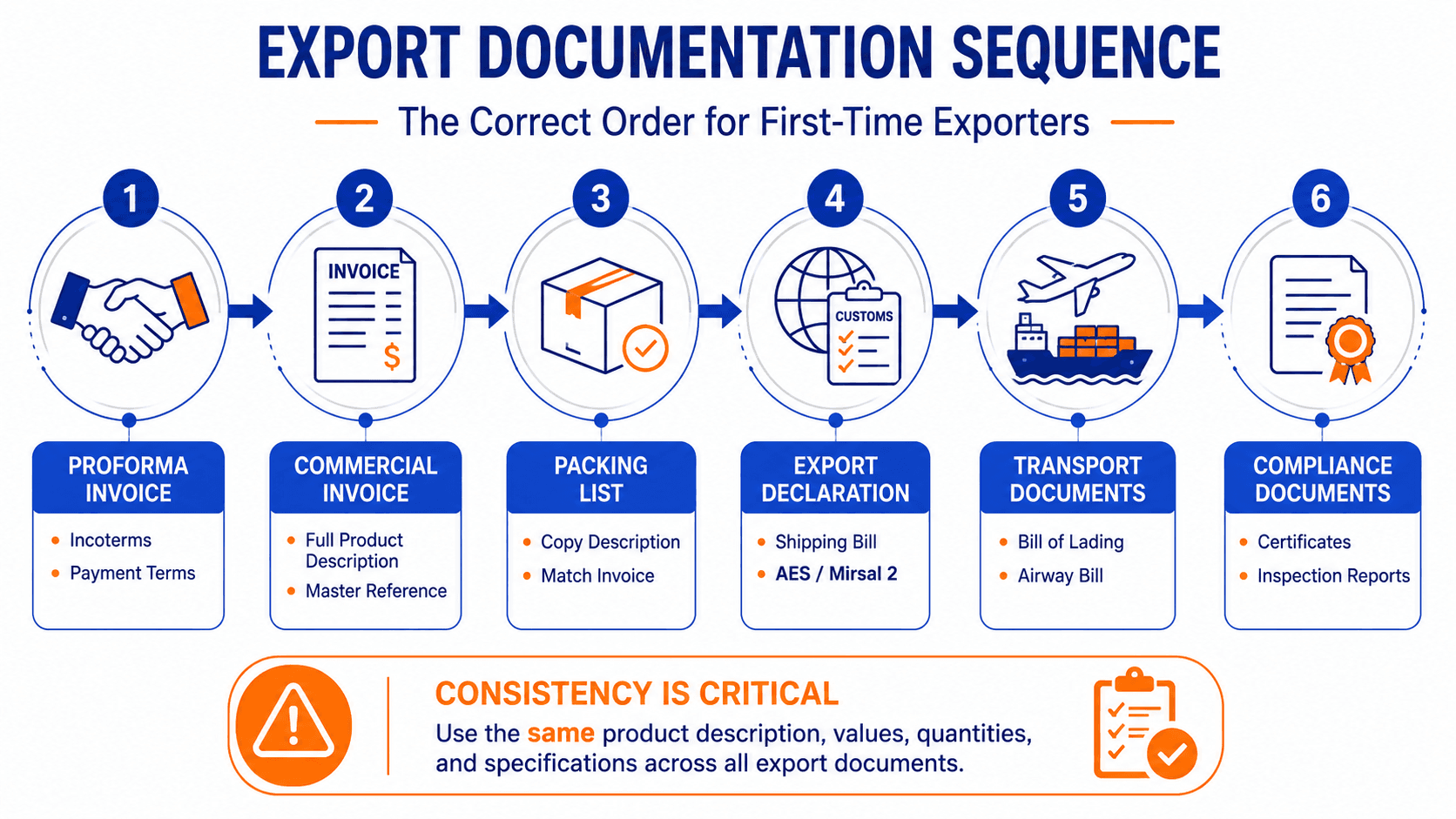
A common mistake is preparing documents out of sequence, which causes the same data to be entered multiple times in slightly different ways across different files. Here is the sequence that avoids that problem.
Step one. Confirm the proforma invoice with your buyer, including Incoterms and payment terms, before anything else is prepared.
Step two. Prepare the commercial invoice using the exact, full product description, including any grade, specification, or technical detail. This becomes your master reference.
Step three. Copy that exact description, word for word, onto the packing list. Do not abbreviate on one document and spell out the full description on another.
Step four. File your country-specific export declaration, whether that is a Shipping Bill, an AES filing, or a Mirsal 2 declaration, using the same product description and values as your commercial invoice.
Step five. Arrange transport documentation, the Bill of Lading or Airway Bill, and confirm every detail matches the invoice and packing list exactly.
Step six. Secure any product-specific certificates, inspection reports, or compliance documents required by the destination market, with enough lead time before your shipping deadline.
Why Document Mismatch Is the Single Biggest Risk
Across every country and every product category, one pattern causes more delays than any other. The same shipment information typed manually into multiple documents, each time slightly differently. A product described as "Stainless Steel Pipes, Grade 304, 6 metre length" on the invoice and "SS Pipes Gr. 304, 6M" on the packing list looks identical to a person. To an automated customs verification system, it reads as two different entries and triggers a query.
This is not a carelessness problem. It is a process problem. Most exporters are managing 10 to 15 documents per shipment, often across spreadsheets, email threads, and manual re-entry, and the opportunity for inconsistency exists at every single transfer point.
How Freightnaut Helps First-Time Exporters Get This Right From Day One
Freightnaut generates your complete export document set, commercial invoice, packing list, certificate of origin, VGM document, and shipping instructions, from a single shipment record. Product descriptions, HS codes, weights, and party names are entered once and populate identically across every document, eliminating the mismatch risk that causes the majority of customs queries and LC discrepancies.
For exporters managing country-specific compliance, custom document templates can be built around the exact fields your destination market or buyer requires, so nothing mandatory is ever missed.
Frequently Asked Questions
Q. What documents are required for international export?
A. At minimum, every international shipment needs a commercial invoice, an export packing list, a certificate of origin, a bill of lading or airway bill, and proof of payment terms such as a Letter of Credit. Beyond this universal set, most countries require an additional country-specific export declaration, such as a Shipping Bill in India, an AES filing in the United States, or a Mirsal 2 declaration in the UAE.
Q. Do export document requirements differ by country?
A. Yes. The universal trade documents, invoice, packing list, certificate of origin, and bill of lading, apply everywhere. But the customs filing system, the registration requirements, and the specific declaration process are different in every country. An exporter shipping from India files through ICEGATE, while an exporter shipping from the United States files through AES.
Q. What is the most common mistake first-time exporters make with documentation?
A. Entering the same shipment information manually into multiple documents, resulting in small wording or formatting differences between the commercial invoice and the packing list. Automated customs verification systems flag these differences as discrepancies even when the underlying product is identical, which is one of the most common causes of shipment delays.
Q. Do I need a certificate of origin for every shipment?
A. Most countries require one for customs clearance, and it becomes especially important if you want your buyer to benefit from reduced duty rates under a trade agreement. Whether you need a preferential or non-preferential certificate depends on whether a trade agreement applies between the origin and destination countries.
Q. What is a VGM document and is it required globally?
A. A Verified Gross Mass document is required under SOLAS regulations for every packed container shipped by sea, regardless of which country you are exporting from. The shipper is responsible for obtaining the verified weight through an approved method, either a certified weighbridge or a calculated total of all cargo items plus the container's tare weight, and declaring it to the shipping line before loading. Freightnaut provides a VGM document template to help you record and organise this information accurately and clearly before submission.
Q. How is export documentation different for engineering or food exporters?
A. General goods need the universal document set covered in this guide. Engineering and industrial goods typically add inspection certificates, technical compliance documents, and in some cases export licensing for controlled technology. Food and agricultural exporters typically add phytosanitary certificates and health or sanitary certificates that are time-sensitive and shipment-specific.