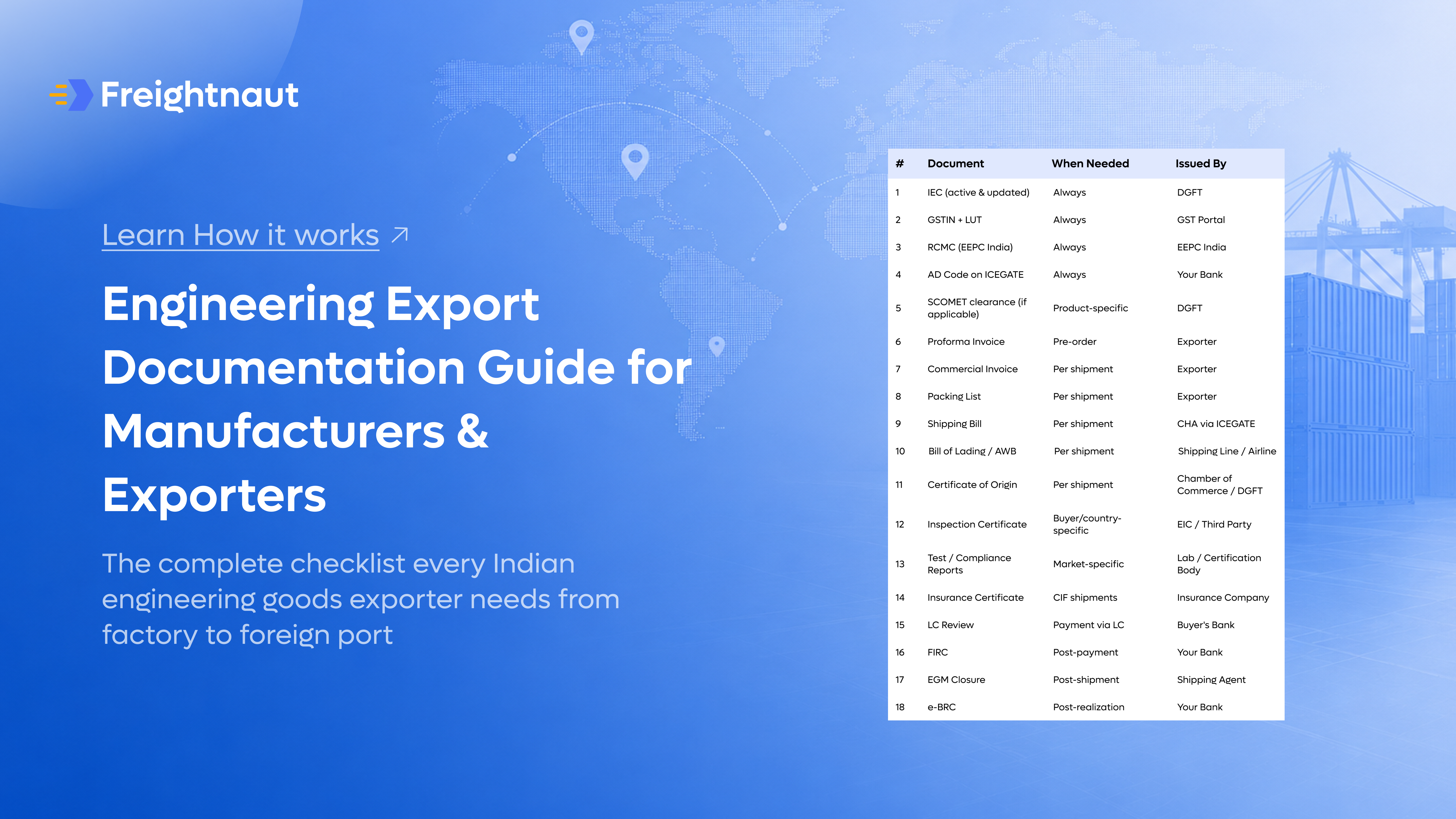
India's engineering goods exports just hit an all-time record $122.43 billion in FY 2025–26, growing nearly 5% year-on-year despite geopolitical headwinds, US tariffs, and Red Sea disruptions. Engineering now accounts for over 27% of India's total merchandise exports, with the USA, EU, UAE, Germany, and the UK as the top buying markets.
If you're an engineering goods exporter making auto parts, industrial machinery, steel products, electrical equipment, or capital goods the global opportunity has never been bigger. But with bigger orders comes bigger documentation risk. One wrong HS code, one mismatched packing list, one missing certificate, and your shipment sits at the port while your buyer waits and your LC clock ticks.
This is the complete checklist every Indian engineering goods exporter needs from the moment goods leave your factory floor to the moment they arrive at a foreign port.
Why Engineering Goods Export Documentation Is Different
Engineering goods are not like FMCG or textiles. They often involve:
High unit values — making customs valuation disputes more costly
Dual-use risk — some items fall under SCOMET (Special Chemicals, Organisms, Materials, Equipment, and Technologies) controls
Technical specifications — requiring inspection certificates and test reports
Multi-SKU shipments — making packing list accuracy critical
Heavy cargo — with strict container weight and dimension documentation
A single mismatch between your commercial invoice, packing list, and shipping bill, even a description difference, can trigger a customs query on ICEGATE, delay your Let Export Order (LEO), and block your RoDTEP claim. In 2026, Indian customs will use digital verification that auto-flags discrepancies. There's no room for manual errors.
PHASE 1: Before the Goods Leave Your Factory
1. Import Export Code (IEC)
Your IEC is the starting point for all exports. It's a 10-digit code issued by DGFT mandatory for every exporter. While it's a lifetime license, it requires a mandatory annual update between April and June on the DGFT portal. Miss this, and your export operations are instantly blocked.
Action: Verify your IEC is active and updated for FY 2026–27 before booking any shipment.
2. GST Registration (GSTIN) + Letter of Undertaking (LUT)
Filing an LUT allows you to export goods at zero-rated GST without paying IGST upfront protecting your working capital significantly. The LUT must be renewed every financial year on the GST portal.
Critical: Goods must be exported within 3 months of the invoice date under LUT. Missing this deadline triggers GST demands with interest and penalties.
3. RCMC — Registration with EEPC India
For engineering goods exporters, the relevant Export Promotion Council is EEPC India. Your RCMC (Registration-Cum-Membership Certificate) is required to claim export incentive schemes like RoDTEP, advance authorizations, and duty exemptions.
Action: Ensure your RCMC is valid and register with EEPC India if you haven't already.
4. AD Code Registration on ICEGATE
Your AD (Authorised Dealer) Code is a 14-digit code issued by your bank that links your export transactions to RBI's foreign exchange monitoring. It must be registered on ICEGATE. The good news: since 2026, a single AD Code registration at one port is valid across all ports with no need for duplicate registrations.
5. SCOMET Check — Is Your Product Controlled?
This step is critical and often missed by engineering exporters. As of September 2025, DGFT issued Notification No. 31/2025-26 revising the SCOMET list, aligning India with international regimes like the Wassenaar Arrangement and MTCR.
If your engineering product involves certain machinery, electronics, materials, or technologies, it may require a SCOMET export license before it can leave India. Check the updated Appendix-3 of Schedule-II of ITC(HS) 2022.
Action: Audit your product line against the revised SCOMET list before every new product category you export.
PHASE 2: The Core Export Documents (Per Shipment)
This is the standard export documentation checklist for every engineering goods shipment from India.
6. Proforma Invoice (PI)
Before the commercial invoice comes the proforma invoice your preliminary offer to the buyer. It must include:
Detailed product description with HS Code
Unit price and total value
Incoterms (FOB, CIF, EXW — these determine who owns freight costs and documentation responsibility)
Payment terms and validity
Net weight and gross weight per unit
Pro tip: Get written buyer confirmation of the PI before proceeding. This becomes the foundation for all downstream documents.
7. Commercial Invoice
The commercial invoice is the primary document for customs valuation and duty assessment. It must match word-for-word with your packing list and shipping bill in terms of product description, HSN code, quantity, and exporter details.
Must include:
Buyer and seller full details
HS Code and product description (exact match across all documents)
Currency and total transaction value
Incoterms clearly stated
GSTIN, IEC, and AD Code references
8. Export Packing List
The packing list is where most engineering exporters make mistakes especially on multi-SKU shipments. Customs officers use this to verify goods without opening every unit. Any discrepancy with the commercial invoice triggers an immediate red flag.
Must include:
Sequential numbering for each box, crate, or pallet
Item-wise breakdown matching the invoice exactly
Gross weight and net weight per package
Dimensions (length × width × height) for each unit
Container number (once allocated)
This is also the document your freight forwarder and cargo insurer rely on for any transit damage claim. An incomplete packing list means an unwinnable insurance dispute.
9. Shipping Bill
The Shipping Bill is the master customs declaration document for Indian exports filed electronically through ICEGATE by your CHA (Customs House Agent). The LEO (Let Export Order) is only issued once this is cleared.
Mark your intent to claim RoDTEP benefits on the Shipping Bill. As of March 23, 2026, the government restored 100% of RoDTEP rates (withdrawing the earlier 50% cut) , a significant boost to margins that only applies if correctly marked.
10. Bill of Lading (B/L) or Airway Bill (AWB)
Issued by your shipping line or airline, this is the contract of carriage and proof of shipment. For engineering goods shipped by sea, the Bill of Lading is also a negotiable document of title; your buyer cannot collect goods at the destination port without it.
Ensure all details vessel name, port of loading, port of discharge, container number match exactly across your invoice, packing list, and shipping bill.
11. Certificate of Origin (CoO)
Required by most importing countries to verify that goods were manufactured in India. There are two types:
Non-Preferential CoO — for general customs purposes, issued by Chambers of Commerce. From January 2025, all applications must be filed electronically through DGFT's portal at trade.gov.in. Physical submissions are no longer accepted.
Preferential CoO — to claim reduced/zero duty under FTAs. For engineering goods exporters, the India-UAE CEPA and India-Japan CEPA are particularly valuable. With India-EU FTA negotiations progressing, this will become even more important.
Cost: ₹200–₹2,000 per certificate depending on membership status.
PHASE 3: Engineering-Specific Documents
12. Inspection / Quality Certificate
Engineering goods often require a pre-shipment inspection either mandated by the buyer's contract or by the destination country's regulations. This can be issued by:
Export Inspection Council (EIC) of India
Third-party agencies approved by the buyer (SGS, Bureau Veritas, TÜV, etc.)
Buyer can reject goods or hold payment if this is missing. Get inspection done well before the shipping date and keep copies for dispute resolution.
13. Test Reports / Technical Compliance Documents
For machinery, electrical equipment, and industrial goods, many markets require proof that products meet specific technical standards:
CE Marking for EU
UL Certification for USA
BIS Certification for certain categories
ISO/Material Test Certificates for steel and metal products
These are not export documents per se but are required by your buyer's customs and must accompany the shipment.
14. Insurance Certificate
If shipping under CIF (Cost, Insurance, Freight) terms, you are responsible for arranging cargo insurance. The insurance certificate must cover the full value of the shipment and be shared with the buyer.
For heavy engineering goods, ensure the policy specifically covers machinery, breakage, and handling risks standard marine cover may not be sufficient.
15. Letter of Credit (LC) or Payment Document
If payment is via LC, review it carefully before shipment. Engineering goods exports on LC often face problems because:
Long transit times (especially post-Red Sea rerouting) can cause LC expiry before arrival
Technical document requirements in LCs are often very specific one wrong word in a product description causes a discrepancy
Coordinate with your bank to extend LC validity if Cape of Good Hope routing adds 2–3 weeks to transit.
PHASE 4: Shipment Visibility: The Step Most Exporters Skip
Here's what separates organized engineering exporters from ones constantly firefighting: real-time shipment tracking.
Once your container is loaded and the Bill of Lading is issued, your visibility shouldn't stop there. Engineering goods shipments especially high-value ones require active monitoring because:
Port congestion, vessel changes, and transshipment delays can happen mid-voyage
If a vessel changes and your LC specifies a vessel name, you need to know immediately to issue an amendment
Buyers expect live shipment visibility, especially on large orders
A shipment tracking platform that gives you live container tracking from factory to port and end-to-end shipment tracking through to delivery means you're never caught off-guard by a delay your buyer finds out about before you do.
PHASE 5: Post-Shipment Documentation
16. FIRC (Foreign Inward Remittance Certificate)
Once your buyer makes payment and the funds arrive in your bank, obtain the FIRC. This is required for:
GST refund claims
RoDTEP benefit processing
Reconciliation under FEMA
17. Export General Manifest (EGM)
Filed by the shipping agent once the vessel departs. The EGM closure is necessary for your RoDTEP and IGST refund processing on ICEGATE.
18. Bank Realization Certificate (BRC) / e-BRC
Issued by your bank once export proceeds are realized. Required for DGFT benefit claims and export turnover certification.
The One Place Everything Goes Wrong: Document Mismatch
In 2026, Indian customs will use automated digital verification that cross-checks every field across your invoice, packing list, and shipping bill simultaneously. Here's what a typical mismatch looks like:
Invoice says: "Industrial Pump, Model XP-200, Cast Iron Body" Packing List says: "Pump, XP-200, CI"
That's the same product. But to the automated system, it's a discrepancy — and your LEO is held until your CHA resolves it manually, which can take 24–72 hours. Multiply that across a multi-SKU shipment with 15 line items, and you're looking at a week of delay before a single container moves.
The fix is simple but requires discipline: every document must use the exact same product description, HS code, quantity unit, and weight figures. No abbreviations, no shortcuts.
This is exactly why engineering exporters are moving to export documentation software that generates all shipment documents from a single data entry invoice, packing list, and shipping bill details all populated from one source, eliminating the possibility of mismatches.
Engineering Goods Export: Quick Reference Checklist
# | Document | When Needed | Issued By |
1 | IEC (active & updated) | Always | DGFT |
2 | GSTIN + LUT | Always | GST Portal |
3 | RCMC (EEPC India) | Always | EEPC India |
4 | AD Code on ICEGATE | Always | Your Bank |
5 | SCOMET clearance (if applicable) | Product-specific | DGFT |
6 | Proforma Invoice | Pre-order | Exporter |
7 | Commercial Invoice | Per shipment | Exporter |
8 | Packing List | Per shipment | Exporter |
9 | Shipping Bill | Per shipment | CHA via ICEGATE |
10 | Bill of Lading / AWB | Per shipment | Shipping Line / Airline |
11 | Certificate of Origin | Per shipment | Chamber of Commerce / DGFT |
12 | Inspection Certificate | Buyer/country-specific | EIC / Third Party |
13 | Test / Compliance Reports | Market-specific | Lab / Certification Body |
14 | Insurance Certificate | CIF shipments | Insurance Company |
15 | LC Review | Payment via LC | Buyer's Bank |
16 | FIRC | Post-payment | Your Bank |
17 | EGM Closure | Post-shipment | Shipping Agent |
18 | e-BRC | Post-realization | Your Bank |
How Freightnaut Helps Engineering Exporters
Managing 18+ documents across every shipment while tracking containers, responding to buyer queries, and chasing banks for payment is not a spreadsheet problem. It's a systems problem.
Freightnaut's export documentation software lets engineering exporters:
Generate customizable export documents — invoices, packing lists, and certificates from a single data entry with zero mismatch risk
Use custom export document templates tailored to your product categories and buyer requirements
Track shipments in real-time with a live shipment tracking dashboard from factory to foreign port
Maintain shipment visibility across multiple active orders simultaneously
Automate export documentation so your team spends time on business, not paperwork
Whether you're exporting auto parts to Germany or industrial machinery to the UAE, Freightnaut gives you a complete export visibility platform built for how Indian engineering exporters actually work.
India's engineering sector hit $122 billion in exports last year. The exporters driving that number aren't doing it with spreadsheets and WhatsApp threads. They're doing it with systems.
Start your free trial with Freightnaut →
Tags: export documentation, export documents list, documents required for export, export documentation software India, export documentation automation, real-time shipment tracking, shipment tracking software, custom export document templates, manufacturing export India, engineering goods export, factory to port tracking, shipment visibility platform, all-in-one export management platform, EEPC India, export documentation procedure