Picture this: your ₹40 lakh container left Mumbai two weeks ago. Your German buyer is emailing asking for an ETA update. Your freight forwarder hasn't responded since Tuesday. The shipping line's portal shows the last update was six days ago at Port Said. And you have absolutely no idea where your cargo is right now.
This is not an unusual situation. This is Tuesday for thousands of Indian exporters.
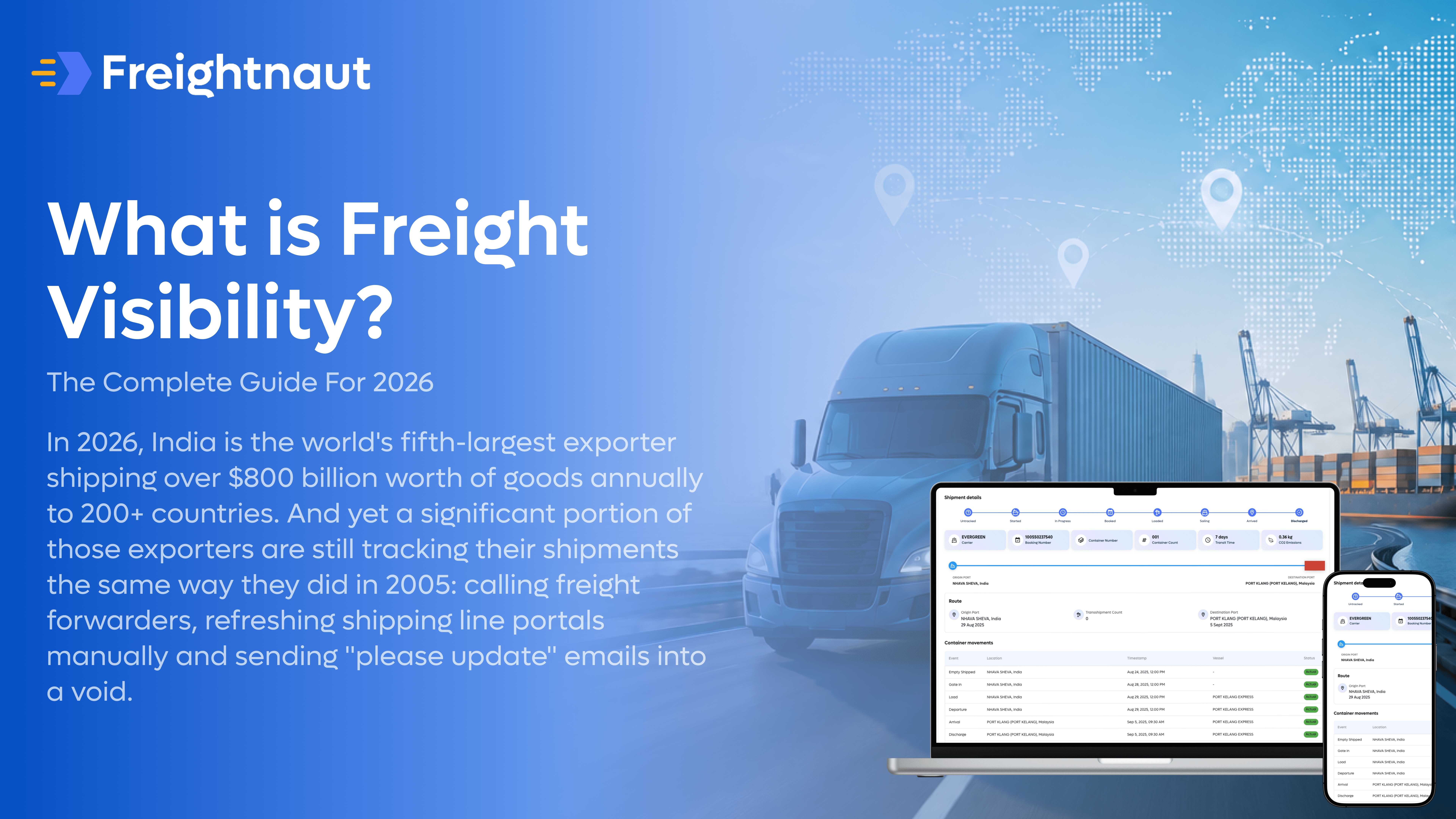
In 2026, India is the world's fifth-largest exporter shipping over $800 billion worth of goods annually to 200+ countries. And yet a significant portion of those exporters are still tracking their shipments the same way they did in 2005: calling freight forwarders, refreshing shipping line portals manually and sending "please update" emails into a void.
The gap between where Indian export logistics is and where it needs to be comes down to one word: visibility.
Real-time shipment tracking isn't a luxury feature for large corporations anymore. It's the operational baseline for any Indian exporter who wants to protect margins, retain buyers and scale without chaos. Here's exactly how it saves you time and money and why 2026 is the year to stop operating blind.
What Is Real-Time Shipment Tracking?
Real-time shipment tracking is the ability to monitor the live location, status, and estimated arrival of your cargo at any point in its journey from your factory floor to the foreign port through a single digital platform.
A proper shipment tracking platform connects to data feeds from shipping lines, airlines, ports, customs systems and AIS satellite networks to give you live, accurate updates on every milestone of your shipment's journey:
Container picked up from factory
Gate-in at origin port
Loaded on vessel
Vessel departed
Transshipment port arrival / departure
Estimated arrival at destination port (ETA)
Customs clearance status
Final delivery confirmation
This is what end-to-end shipment tracking looks like not just knowing your container number, but knowing exactly where it is, what's happening to it and what the updated ETA is, in real time.
The Real Cost of Operating Without Shipment Visibility
Before we talk about savings, let's talk about what the absence of real-time tracking actually costs Indian exporters. Because this isn't just a convenience problem it's a money problem.
Cost 1: Buyer Relationship Damage
About 21% of all support tickets in logistics are "Where Is My Order?" requests. For B2B exporters, the equivalent is the constant buyer email asking for shipment updates. Every time a buyer has to chase you for cargo status, your relationship takes a small hit. Over time, those hits accumulate and buyers start looking for suppliers who proactively keep them informed.
In export, your buyer's trust is your most valuable asset. An exporter who sends unsolicited ETA updates before the buyer asks signals professionalism. An exporter who can't answer "where is my order?" signals risk.
Cost 2: LC and Payment Delays
When your shipment is delayed and you don't know about it in real time, you can't act on it fast enough. Your Letter of Credit has an expiry date. Your buyer's receiving warehouse has a booking. Your freight forwarder is handling 200 other shipments.
Exporters who catch a vessel change or port delay within hours can contact their bank to amend the LC, notify the buyer proactively, and adjust downstream logistics. Exporters who find out three days later from a forwarded email are filing emergency amendments, losing buyer goodwill and potentially missing payment windows entirely.
Cost 3: Working Capital Trapped in Transit
Without visibility, extra costs hide in plain sight: failed deliveries, slow routes, carrier penalties. Every day your shipment sits unaccounted for is a day your working capital is locked in transit. If you don't know your cargo is stuck at a transshipment port, you can't escalate with the carrier, you can't notify your buyer, and you can't plan your next production cycle around when payment will arrive.
For MSME exporters operating on 30–60 day payment cycles, this is a cash flow crisis in slow motion.
Cost 4: Manual Tracking Hours Add Up Fast
Here's a calculation most exporters never make. If your team spends 2 hours per week per active shipment checking carrier portals, emailing freight forwarders, and updating internal trackers and you have 10 active shipments at any given time that's 20 hours per week of staff time spent on something a tracking platform does automatically.
At a conservative ₹300/hour cost of staff time, that's ₹6,000 per week over ₹3 lakh per year spent on manually doing what a shipment tracking dashboard does in seconds.
7 Ways Real-Time Shipment Tracking Saves Indian Exporters Time and Money
1. Catch Delays Before Your Buyer Does
A live shipment tracking solution monitors your cargo 24/7 including nights, weekends and public holidays when your team isn't watching. When a vessel is rerouted, a container is rolled to the next sailing, or a port is experiencing congestion, your tracking platform flags it immediately.
This gives you a critical window: you find out before your buyer does. You can send a proactive update, offer a revised ETA, and demonstrate control over the situation instead of scrambling to respond to an angry buyer email that arrived while you were in a meeting.
A good tracking tool shows you which carriers perform well, which routes waste time, and which deliveries create claims with that insight, you can adjust contracts, optimize delivery zones, and save money without cutting quality.
2. Eliminate Hours of Manual Carrier Portal Checking
Every Indian exporter with active sea shipments knows the ritual: open Maersk portal, enter container number, check status, open MSC portal, repeat, open CMA CGM portal, repeat across 5 shipping lines, 10 active containers, twice a day.
A container tracking system aggregates all this into a single shipment tracking dashboard one login, all shipments, all carriers, all updated automatically. By automating tracking and notifications, businesses save time and avoid manual tracking errors.
Your team stops being data entry clerks and starts being decision-makers.
3. Protect Your LC Payments With Early Warning
This is the most financially significant benefit for Indian exporters and the least talked about.
When your live container tracking shows a vessel has been delayed by 5 days at a transshipment port, and your LC expires in 8 days, you have a 3-day window to act. You contact your bank, request an amendment, notify your buyer, and the LC is extended before it lapses.
Without real-time tracking, you find out 3 days later when the shipping line updates their portal. Your LC has 2 days left. The amendment process takes 3–5 days. Your payment is blocked.
Real-time shipment visibility isn't just an operational tool it's a payment protection tool for exporters working on LC terms.
4. Improve Buyer Trust and Win Repeat Orders
Businesses save time and avoid manual tracking errors some platforms even offer analytics and carrier performance data to optimize shipping routes and control costs.
Beyond the operational benefits, live shipment visibility directly impacts your buyer relationships. When you can share a tracking link or proactive status update with your buyer without being asked showing them exactly where their cargo is and what the current ETA is you're not just a supplier anymore. You're a reliable partner.
In competitive export categories like textiles, engineering goods, and pharma, where multiple Indian suppliers compete for the same international buyer, shipment visibility is a differentiator. Buyers choose exporters they trust. And trust is built on transparency.
5. Reduce Demurrage and Detention Costs
Demurrage (charges for keeping a container at the port beyond free time) and detention (charges for keeping the container outside the port beyond free time) are among the most painful and avoidable costs in export logistics.
They happen for one reason: the exporter didn't know the container had arrived and free time was running out.
With real-time cargo tracking, your platform alerts you the moment your container arrives at the destination port so your buyer's customs agent is notified immediately, clearance begins on time, and free time isn't wasted. For exporters shipping to markets like the UK, Germany, or the UAE where port congestion and free time windows are tight, this alert alone can save ₹50,000–₹2,00,000 per container in avoidable charges.
6. Make Smarter Carrier and Routing Decisions
When you track performance through software, you know who meets deadlines and who doesn't you go into rate discussions with facts, not stories. That changes the balance of power in your favor.
Over time, your shipment tracking platform builds a data record of every shipment which carriers were on time, which routes had the fewest delays, which transshipment ports caused the most congestion. This isn't just historical data it's negotiating leverage.
When you approach a shipping line for a rate discussion and you can show them 6 months of on-time performance data, you negotiate from a position of knowledge. When you can compare two routing options by historical transit reliability, you make smarter decisions than an exporter guessing based on price alone.
7. Scale Your Export Operations Without Scaling Your Team
Here's the operational ceiling every growing Indian exporter hits: at 5 active shipments, one person can manually track everything. At 15 active shipments, it's chaos. At 30 active shipments, it's impossible without more people.
A shipment visibility platform breaks that ceiling. Whether you have 5 shipments or 500, your shipment tracking dashboard shows every container's status at a glance with exception alerts flagging only the ones that need attention. Your team focuses on exceptions, not routine status checks.
Wider adoption of real-time tracking is cutting documentation time and improving transparency and for Indian exporters, this means being able to grow your export volume without proportionally growing your back-office headcount.
What Does a Shipment Tracking Dashboard Actually Show?
A good shipment tracking dashboard built for Indian exporters gives you:
Feature | What It Means for You |
Live Container Location | See exactly where your container is on a map vessel position, port, or terminal |
Milestone Alerts | Get notified at every key event gate-in, vessel departure, transshipment, arrival |
ETA Predictions | Know the updated estimated arrival, not just the original scheduled date |
Vessel Change Alerts | Immediately notified if your cargo is rolled to a different vessel |
Multi-Shipment View | All active shipments in one screen not spread across 5 carrier portals |
Delay Flagging | Exceptions highlighted automatically no manual searching for problems |
Buyer Sharing | Share live tracking status with your buyer directly from the platform |
Historical Performance | Track which carriers and routes perform best for your business |
How Real-Time Tracking Works: Factory to Foreign Port
Here's what end-to-end shipment tracking looks like for a typical Indian export shipment:
Stage 1 — Factory to Port (Pre-Shipment) Once the container is picked up from your factory, live shipment tracking confirms the container number, seal number, and gate-in status at the origin port. You know your cargo made it to port and so does your buyer.
Stage 2 — Port of Loading Your tracking platform shows container loading confirmation onto the vessel, vessel name, voyage number, and actual departure time cross-referenced against your Bill of Lading details.
Stage 3 — At Sea Using AIS satellite data, your platform tracks the vessel's live position across the ocean updated multiple times daily. You see if the vessel is on schedule, diverted, or slowing down due to weather.
Stage 4 — Transshipment Port (if applicable) For most India-Europe or India-North America routes (especially via Cape of Good Hope), cargo transships at an intermediate port. Your tracking system monitors container discharge and re-loading a critical point where cargo can be delayed or misrouted.
Stage 5 — Destination Port Arrival confirmation, berth status, and customs clearance updates so your buyer's agent is ready the moment the container is available for collection.
This is complete export visibility from the moment cargo leaves your factory to the moment it reaches the foreign port. No gaps. No guessing.
The 2026 Context: Why This Matters More Than Ever
Three things have made real-time shipment tracking more essential for Indian exporters in 2026 than at any previous point:
1. Red Sea Disruptions Cape of Good Hope rerouting has added 10–14 days to Europe-bound shipments with more frequent vessel changes, transshipment port switches, and ETA revisions. Exporters without live tracking have no visibility into these mid-voyage changes until they become problems.
2. India's Government Is Already Moving on This India's National Industrial Corridor Development Corporation (NICDC) announced enhancements to its logistics data bank system, enabling real-time tracking of export containers on the high seas and domestic truck movements. The system's comprehensive real-time tracking capabilities provide visibility across road, rail, and sea transport modes. The government is building infrastructure for tracking exporters who aren't using tracking platforms are falling behind even the national logistics standard.
3. Buyer Expectations Have Risen Permanently 91% of consumers actively track their packages and B2B buyers in Europe, the USA, and the UAE now expect the same transparency from their Indian suppliers that they get from Amazon. Shipment visibility is no longer a premium feature. It's a baseline expectation.
How Indian Exporters Are Using Real-Time Tracking Right Now
Textile Exporters in Surat and Tirupur are using live container tracking to give their European buyers automated status updates reducing buyer queries by over 50% and freeing up their customer service teams for value-added work.
Engineering Goods Exporters in Pune and Faridabad are using multi-shipment tracking dashboards to manage 20–30 active shipments simultaneously, something that previously required 2–3 dedicated staff manually checking carrier portals.
Pharma Exporters from Hyderabad are using shipment visibility platforms to monitor cold chain shipments in real time getting immediate alerts if a temperature-controlled container is delayed at a transshipment port where cold storage needs to be arranged.
MSME exporters across Maharashtra and Gujarat are using tracking data to negotiate better freight rates with carriers going into discussions with 6 months of on-time performance data instead of gut feel.
Track Shipments and Create Export Documents In One Platform
Here's where Freightnaut is different from a standalone tracking tool.
Most shipment tracking software only tracks. But every Indian exporter knows that tracking and documentation are two sides of the same operation. When a vessel changes and your ETA shifts by a week, you don't just need to know you need to act. You need to notify your bank, update your LC, issue a revised packing list, and communicate with your buyer.
Freightnaut combines real-time shipment tracking with export documentation automation so when something changes in your shipment, you can respond with updated documents immediately, from the same platform.
Here's what that means in practice:
Real-time shipment tracking — live container location tracking from factory to foreign port
Shipment tracking dashboard — all active shipments in one place, with milestone alerts and ETA updates
Live shipment visibility — shareable tracking status for your buyers, no separate login needed
End-to-end shipment tracking — from gate-in at origin port to arrival at destination
Export documentation automation — generate invoices, packing lists, and certificates automatically alongside your tracking data
Custom export document templates — your document formats, pre-populated with shipment data so there's zero mismatch
All-in-one export management platform — tracking and documentation in one workflow, not two separate tools
This is what complete export visibility looks like for Indian exporters in 2026.
How to Track a Shipment in Real Time Getting Started
If you're still tracking shipments manually, here's what the switch to a shipment tracking platform looks like:
Step 1: Enter your container number or Bill of Lading number into the platform once
Step 2: The platform connects to the shipping line's live data feed automatically Step 3: Set your milestone alerts vessel departure, transshipment, arrival and choose who gets notified
Step 4: Share the live tracking link with your buyer so they can check status anytime
Step 5: Watch your "where is my shipment" emails drop to zero
The onboarding takes minutes. The time savings start immediately.
The Bottom Line
Every day an Indian exporter operates without real-time shipment tracking is a day they're:
Spending hours on manual portal-checking that a platform does automatically
Risking LC payment delays because they learned about a vessel change too late
Damaging buyer trust with reactive instead of proactive communication
Missing demurrage alerts that cost lakhs per container
Making carrier and routing decisions based on gut feel instead of data
Shipment tracking software isn't a cost it's a margin protection tool. It's the difference between knowing what's happening to your cargo and hoping everything is fine.
India's top exporters know where their containers are. Right now. All of them.
Do you?
Freightnaut gives Indian exporters real-time shipment tracking, live container visibility, and export document automation in one platform. No more checking five carrier portals. No more reactive buyer emails. No more guessing.
Start your free trial — track your first shipment in minutes →
Tags: real-time shipment tracking, shipment tracking software, live container tracking, container tracking system, shipment tracking platform, real-time cargo tracking, live shipment visibility, shipment tracking dashboard, end-to-end shipment tracking, track shipment in real-time, shipment visibility platform, container location tracking, how to track shipments in real-time, best shipment tracking software, real-time tracking for exporters, track cargo from factory to port, export documentation software India, all-in-one export management platform, complete export visibility platform, shipment tracking + document automation, unified export management system, export documentation automation, Indian exporters logistics, MSME exporters India