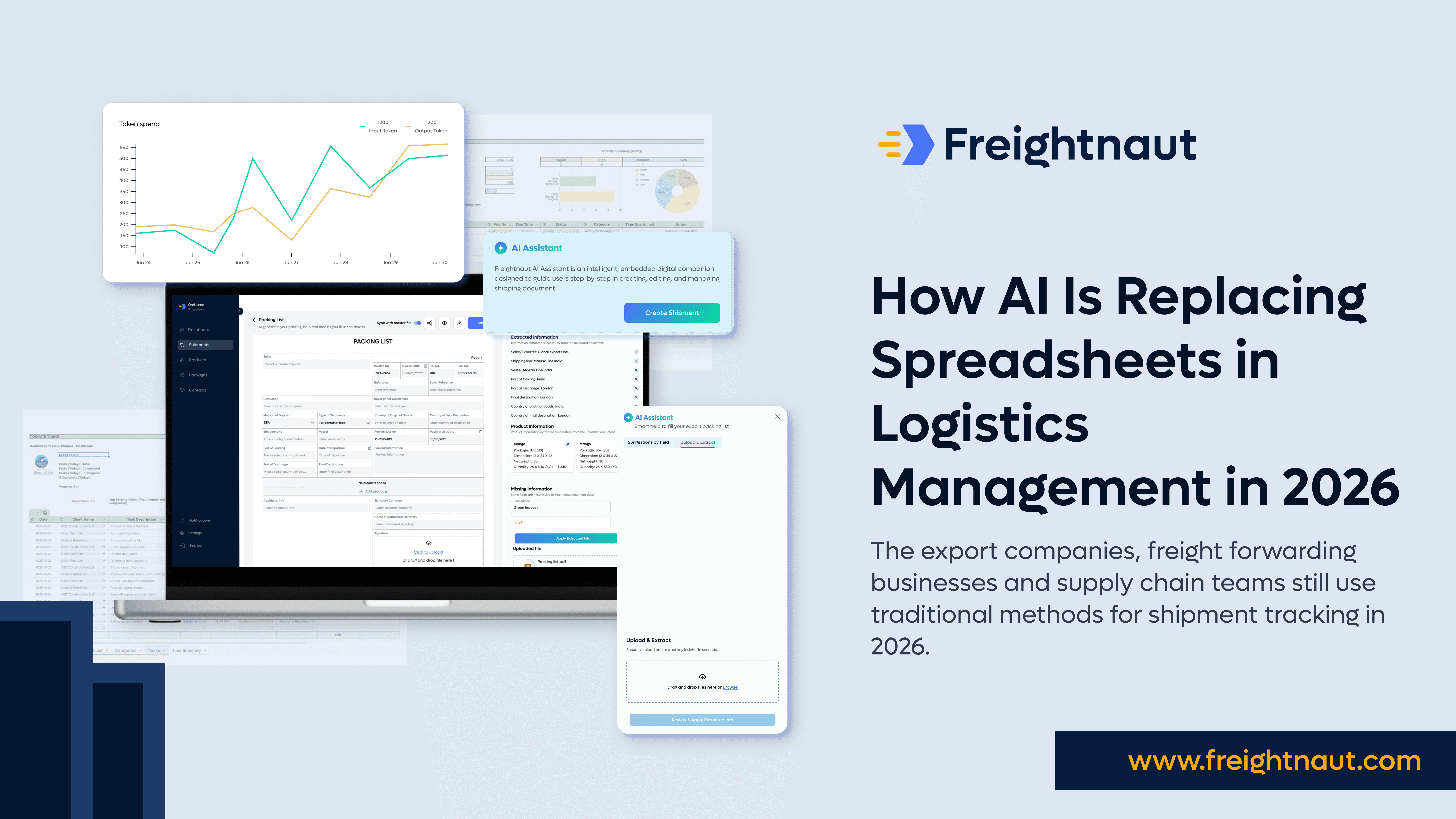
The export companies, freight forwarding businesses and supply chain teams still use traditional methods for shipment tracking in 2026. The shipment information gets documented through Excel spreadsheets. Folders contain the storage space for invoice documents. The email threads serve as the method for distributing updates to recipients.
The process appears to be under control when you first examine it. But spreadsheets begin to create increasing problems when shipment volumes
increase and operational complexity rises.
Logistics operations in the present day need three essential elements which include fast performance, precise results and complete operational monitoring. Organizations that keep practicing manual work methods face difficulties because they experience operational delays and incorrect data and their teams fail to work together effectively.
The majority of organizations have decided to use artificial intelligence (AI) for their logistics activities because it helps them run their export operations and shipment processing more effectively.
Organizations now prefer to use centralized systems which deliver automatic updates about live operations instead of using separate document storage solutions.
Why Spreadsheets Create Problems in Logistics Operations
The initial purpose of spreadsheets was to arrange data, but logistical processes require continuous data updates.
Shipment schedules change frequently. Inventory levels move daily. Documents get updated. Transport routes shift because of weather or congestion.
Information that changes frequently causes spreadsheets to lose their accuracy. Logistics managers share common difficulties that many other professionals face, such as;
Manual data entry taking hours each day
Shipment information stored in multiple Excel files
Errors in invoices and export documents
Delays caused by missing updates
Teams working with outdated shipment information
Difficulty tracking shipment status
Teams face a common problem when they create several copies of the same spreadsheet. The current situation makes it impossible to identify which document holds the most recent data.
This situation creates two problems which result in slower decision processes.
The manual tracking system prevents organizations from achieving the shipment visibility which their customers and partners now demand.
The expansion of businesses makes it increasingly difficult to operate using spreadsheet systems.
How AI Is Improving Logistics Management
AI technology supports logistics companies with solutions for their daily operational challenges.
The AI logistics management software system removes the need for manual data entry by automatically gathering and organizing information.
Logistics teams can decrease their time spent on standard operations because of this system which enables them to dedicate more time to their planning and coordination tasks.
AI implementation in logistics operations provides companies with improved operational visibility, enhanced accuracy, and increased efficiency.
The following applications of AI in logistics operations provide the most significant advantages to users.
Predicting Shipment Delays
Shipment delays often occur because of three main reasons which include adverse weather conditions, port congestion and interruptions to carrier services.
AI systems use historical shipment data alongside external factors to determine shipment risk levels at an early stage. The system enables teams to modify their schedules, which allows them to notify customers about potential issues before they arise. Early visibility helps decrease the number of unexpected disruptions that happen at the last minute.
Automatic Shipment Tracking
Automatic shipment tracking system enables tracking of shipments without manual shipment tracking operations which need multiple source checks through carrier portals and email systems. The AI shipment tracking system gathers data from several systems to provide continuous shipment status updates. The logistics managers access all updates through a single platform which eliminates their need to review multiple email and spreadsheet documents. The solution enhances team coordination by improving their ability to collaborate on work.
Export Document Processing
The process of export document processing requires more work because its export documentation procedure suffers from high error rates during manual data entry. The shipment process gets delayed while extra expenses arise because of mistakes in the invoice and packing list documents.
The export management software which uses AI technology can understand documents to find both missing and incorrect data. The process helps to decrease documentation mistakes while it supports better compliance with regulations.
Can AI Replace Spreadsheets in Export Management
The ability of AI systems to take on spreadsheet functions for handling export operations remains unproven according to logistics teams who inquire about this capability. Most companies prefer to use spreadsheets for everyday operations which remain their primary method of work despite all other systems available today. The AI-based systems for logistics management create a unified system which integrates all operational data through its centralized platform. Teams can operate their business processes through one comprehensive system which eliminates the need to keep shipment data in multiple separate records. The standard components of this system include;
Shipment details
Export documents
Inventory updates
Cost tracking
Customer information
The automatic information updates eliminate the requirement for teams to keep different file editions when all updates occur. The system decreases operational complexity while it eliminates the need for workers to handle tasks through manual procedures. The centralized systems enable better operational management through their ability to control processes which become more complex than spreadsheet functions permit.
Key Features of Modern Logistics Management Software
Logistics managers today are responsible for more than tracking shipments. They require operational visibility together with enhanced cost management capabilities.
Modern logistics automation software helps teams manage operations more effectively.
The following capabilities represent essential functionalities of the system.
Workflow Automation
The shipment process involves multiple steps which begin with booking and continue through documentation and delivery tracking.
Automation tools decrease the need for manual updates while they enable departments to share information without interruptions.
The system helps to decrease delays which occur because of communication problems between different parties.
Intelligent Document Processing
The process of export operations needs to handle multiple document types which include both commercial invoices and packing lists.
The AI tools extract document data while they perform automatic accuracy verification processes.
The system reduces manual entry work which leads to better operational performance.
Real Time Operational Visibility
The centralized dashboard system enables logistics managers to track shipments and inventory and document status during all times of the day.
The system enables managers to access information about all teams without needing to request updates. Because of this organizations that have better visibility into their operations can make decisions at a quicker pace than before.
Data Driven Planning
AI systems use operational data analysis to find patterns and detect potential hazards.
The system enables businesses to enhance their shipment planning processes and achieve better cost management.
The implementation of improved planning methods leads to fewer operational disturbances.
Why Logistics Companies Are Moving Toward Automation
The world of international commerce experiences greater complexity every year. Businesses face increasing pressure to deliver faster and operate more efficiently.
Customers expect shipment information to be delivered with complete accuracy. Export regulations require proper documentation. The organization requires precise control over its expenses.
The organization may faces difficulties in meeting its demands because of its reliance on manual operations.
Companies that implement supply chain automation will achieve operational benefits that include:
Faster shipment processing
Improved capacity to track shipments
Decreased need for manual labor
Decreased need for manual labor
Improved team teamwork
Logistics specialists use automation to free their time from routine work so they can concentrate on planning activities and serving customers.
The Future of Logistics Management
Logistics operations have progressed into a stage where data analysis drives their activities. Organizations that depend exclusively on spreadsheets will face difficulties in handling the rising complexity of their operations.
Organizations can achieve greater operational control through their connected systems which provide them with complete visibility and precise system measurements.
AI-based solutions enable logistics teams to handle their increasing shipment volume requirements while decreasing their need for manual labor.
Spreadsheets will remain practical for basic functions, but they no longer meet the requirements of contemporary export business management.
Companies that implement advanced logistics management systems gain a competitive edge because they can handle business expansion and market fluctuations.
Businesses that adopt modern logistics management tools are better positioned to grow and adapt to changing market conditions.
The use of spreadsheet software for managing logistics operations becomes effective at handling small volumes of work yet proves challenging when operations reach larger scale. AI-powered logistics management software enables companies to enhance their operational visibility while decreasing their manual workload and eliminating costly mistakes. Organizations that modernize their logistics processes can operate more efficiently and respond faster to changes. Companies that want better shipment tracking and export management should stop using spreadsheet systems for their operations.
Learn more about AI-powered logistics management solutions: