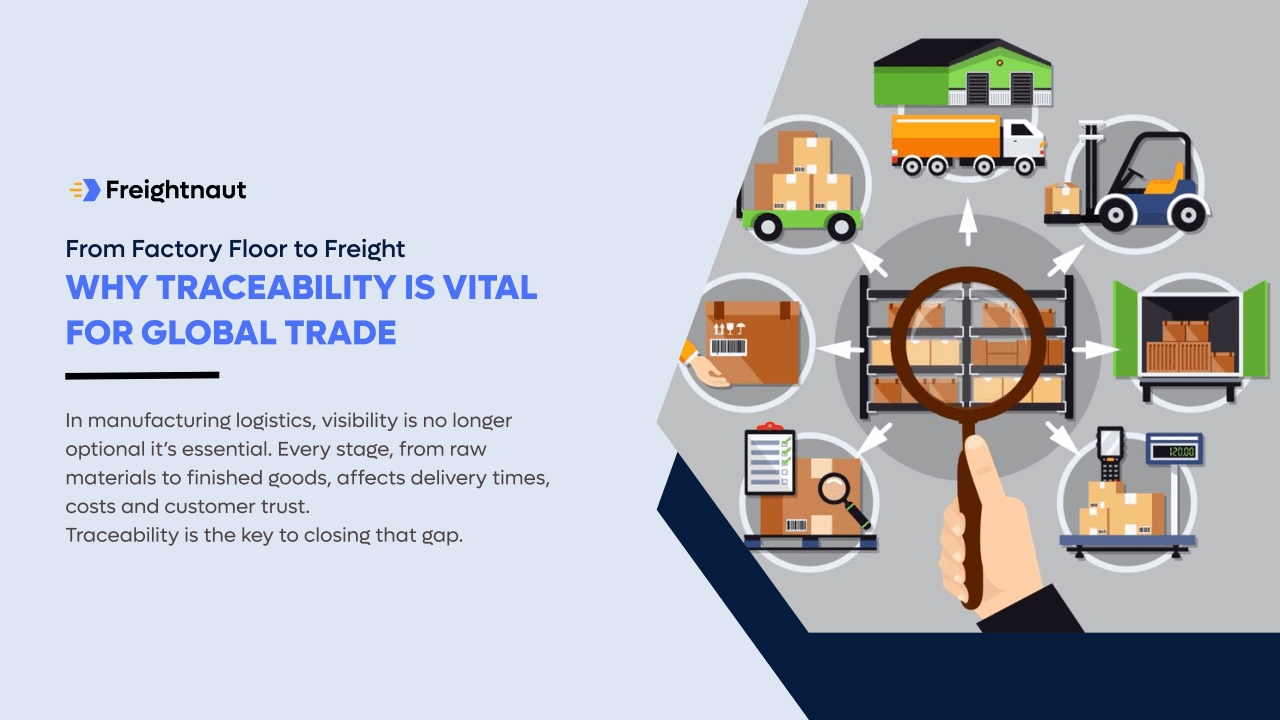
Global trade has never been more connected or more complicated. Today’s supply chains stretch across continents, with suppliers, shippers, and regulators all playing their part. Yet, many exporters and manufacturers still manage these complex networks with spreadsheets and basic accounting tools.
That’s a big problem.
According to recent studies, 70% of businesses cite lack of supply chain visibility as their biggest challenge, and only a small fraction have true end-to-end traceability. The result? Missed deadlines, compliance risks, and costly disputes that could’ve been avoided.
What Traceability Really Means
Tracking tells you where your shipment is. Traceability tells you how it got there every process, every handoff, every approval.
True digital traceability creates a single, real-time view of your operations from procurement to production to export. It connects the dots between suppliers, manufacturers, logistics providers, and compliance systems, giving you clarity instead of chaos.
Why It Matters
1️. Compliance & Trust
Every country has changing trade rules and safety standards. Without traceability, it’s easy to source from restricted suppliers or miss documentation deadlines putting your licenses and reputation at risk. Traceability ensures every product and shipment can be audited, certified, and verified at any stage.
2️. Faster Dispute Resolution
Disputes happen late deliveries, damaged goods, missing paperwork. With traceability, every event is logged and timestamped, giving all partners one shared truth. No more endless emails or blame games just fast, fact-based resolutions.
3️. Operational Efficiency
Real-time visibility across production and logistics helps teams act proactively, not reactively. When everyone sees the same data from inventory to shipment decisions are faster, workflows are leaner, and errors drop dramatically.
The Spreadsheet Trap
Many mid-sized exporters are still “running on Excel” or Tally. They manage inventory in one sheet, shipments in another, and communication through endless WhatsApp threads.
This patchwork leads to data silos, version errors, and zero real-time insight. By the time reports are compiled, the reality has already changed.
The cost? Delayed shipments, compliance fines, and lost opportunities.
Lessons from the Industry
When the Suez Canal was blocked in 2021, $60 billion of trade stopped in a week. Companies with traceability knew exactly which containers were stuck they could plan ahead and inform customers. Those without visibility? They waited in the dark.
On the other end of the spectrum, Walmart’s blockchain-based traceability cut the time to trace a package of mangoes from 7 days to 2.2 seconds proving how technology can turn chaos into control.
The Future: From Tracking to Traceability
Traceability isn’t just a compliance tool it’s a strategic advantage. It builds transparency, strengthens supplier relationships, and helps businesses stay resilient in the face of disruptions.
As global trade becomes more data-driven, companies that can trace will lead and those that can’t will fall behind.
It’s time to move beyond spreadsheets and build supply chains that are transparent, efficient, and resilient.
Freightnaut ERP helps exporters and manufacturers achieve full traceability connecting production, quality, logistics, and compliance into one smart system.
Trace smarter. Ship faster. Freightnaut Simplifying Global Trade for the Modern World.