India is the world's kitchen and the world knows it.
In FY 2024–25, India exported over $51.2 billion worth of agricultural and processed food products rice, spices, marine products, fresh fruits, buffalo meat, processed foods, and more to over 150 countries. APEDA-promoted exports alone recorded 7% growth in April–November 2025–26, reaching $18.6 billion, with projections pointing toward crossing the $30 billion mark in the current financial year.
India contributes 45% of the global spice trade volume. It is the world's largest rice exporter shipping over 22 million tonnes annually. Its marine sector supplies shrimp to the USA and EU at scale. And its processed and ready-to-eat food segment is growing at 12–14% CAGR, fuelled by Indian diaspora demand and a growing global appetite for authentic, traceable food products.
The opportunity for Indian food and agri exporters has never been bigger.
But here's the catch: food and agricultural exports are the most heavily regulated category in Indian export trade. More documents, more certifications, more compliance checkpoints and more reasons for shipments to get rejected, held, or turned back at foreign ports than almost any other export sector.
One missing FSSAI certificate, one expired phytosanitary certificate, one incorrectly labelled package, and your entire consignment can be rejected at the destination returned to India at your cost, or worse, destroyed at the port.
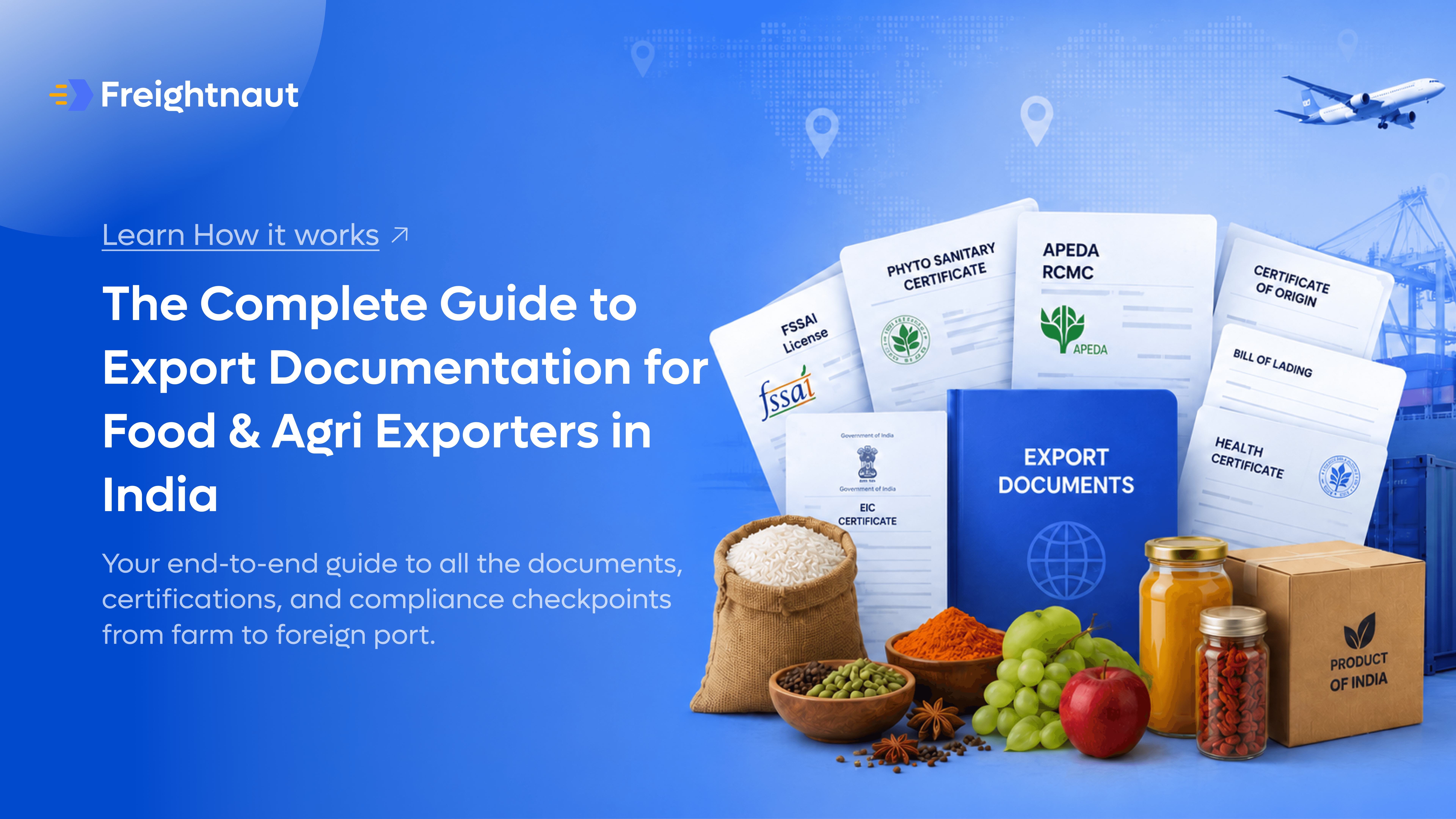
This is the complete guide every Indian food and agri exporter needs covering every document, every certification, and every compliance checkpoint, from farm to foreign port.
TABLE OF CONTENTS
Why Food & Agri Export Documentation Is Different
Part 1: One-Time Registrations (IEC, FSSAI, APEDA, Spices Board, MPEDA, EIC, GST)
Part 2: Per-Shipment DocumentsThe Core Set
Part 3: Food & Agri Specific Documents (Phytosanitary, Health Cert, CoA, Organic, Halal, Fumigation, Insurance)
Part 4: The Labelling Problem That Costs Indian Exporters Crores
Part 5: Cold Chain Documentation
Master Document Checklist (22 Documents)
Most Common Rejection Reasons and How to Avoid Them
How Freightnaut Helps Food & Agri Exporters
Why Food & Agri Export Documentation Is Different
Engineering goods exporters deal with maybe 12–15 documents per shipment. Food and agri exporters can face 20+ documents and certifications depending on the product, destination, and buyer requirements.
Why so many? Because food crosses three critical regulatory zones:
1. Indian Regulatory Compliance FSSAI, APEDA, EIC, Spices Board, MPEDA, and other bodies govern what can leave India and in what condition.
2. International Phytosanitary and Sanitary Standards Importing countries impose strict SPS (Sanitary and Phytosanitary) standards to protect their domestic agriculture and public health. Fail these and your cargo doesn't enter.
3. Market-Specific Certifications The USA wants FDA compliance. The EU demands organic certification if you're claiming organic. GCC markets require Halal. Japan wants specific pesticide residue limits. Every market has its own layer.
Understanding which documents apply to your specific product and destination is the starting point for every food export shipment.
PART 1: One-Time Registrations Every Food & Agri Exporter Needs
Before your first shipment, these registrations must be in place. Without them, your export operations cannot begin or your incentive claims will be rejected.
1. IEC — Import Export Code
The foundation of all exports. A 10-digit code issued by DGFT mandatory for every exporter in India, food or otherwise.
Critical reminder: Annual mandatory update required between April and June on the DGFT portal. A lapsed IEC blocks all export operations instantly.
How to apply: dgft.gov.in | Fee: ₹500 | Typical processing: 2–5 working days
2. FSSAI License Food Safety and Standards Authority of India
The single most important food-specific registration for Indian food exporters.
Any business exporting food products from India processed foods, packaged goods, beverages, dairy, snacks, ready-to-eat meals, spices in branded packs must hold a valid FSSAI license. This is not optional. It is a strict legal requirement under the Food Safety and Standards Act, 2006.
Three types of FSSAI license:
License Type | Annual Turnover | Fee Per Year |
Basic Registration | Below ₹12 lakh | ₹100 |
State License | ₹12 lakh – ₹20 crore | ₹2,000–₹5,000 |
Central License | Above ₹20 crore OR exports | ₹7,500 |
For exporters: A Central FSSAI License is required if you're exporting food products regardless of turnover. This applies even if your annual turnover is below ₹20 crore. A Basic or State license is not sufficient for exports Central is the minimum.
FSSAI License Number on Labels Non-Negotiable
This is one of the most commonly overlooked compliance points and one of the most common reasons Indian food shipments get rejected or recalled at the destination.
Your 14-digit FSSAI license number must appear on every product label including export labels. It must be printed clearly, not stickered over or hidden. The format required is:
"FSSAI Lic. No. XXXXXXXXXXXXXX" printed on the primary label or back panel
This applies to every individual retail pack, every bulk bag, and every outer carton label in your shipment. If even one package in a consignment is found without a valid FSSAI license number, customs at the destination port can reject the entire container not just the non-compliant packs.
Action: Audit every label format you use retail packs, bulk packs, and master carton labels and verify the FSSAI number is printed correctly before any shipment is packed.
FSSAI Product Approval The Step Most Exporters Miss
Getting a Central FSSAI License is not always enough. For certain product categories, FSSAI also requires product-level approval or registration before those products can be manufactured and sold — including exported.
Which products need FSSAI product approval?
Novel foods and ingredients - any ingredient not traditionally used in India (e.g., certain functional ingredients, new food additives, fortified products with non-standard nutrients)
Foods with non-permitted additives — if your formulation uses a food colour, preservative, or additive not on FSSAI's approved list, you cannot export it without approval or reformulation
Proprietary foods — any packaged food product that doesn't conform to FSSAI's existing product standards is classified as a "Proprietary Food" and requires a specific product registration/approval before manufacture
Nutraceuticals and health supplements — separate FSSAI product approval required under Food Safety and Standards (Health Supplements, Nutraceuticals, etc.) Regulations
Organic foods — must also hold NPOP (National Programme for Organic Production) certification alongside FSSAI license
What happens if you skip product approval?
Your product can be manufactured and shipped but when the importing country's customs authority or your buyer's quality team checks the FSSAI compliance documentation and finds your product is classified as Proprietary Food without approval, the shipment can be refused. Worse, if FSSAI enforcement detects it on the Indian side, your export consignment can be held before it even reaches the port.
Action: Before exporting any new product category, check FSSAI's product standards list at fssai.gov.in. If your product doesn't fit a standard category, apply for Proprietary Food registration the process can take 30–90 days, so plan well ahead of your first shipment date.
Destination-specific requirements:
USA: Requires FDA (Food and Drug Administration) prior notice registration for all food imports. Indian food exporters targeting the US need to register their facility with the USFDA separately your FSSAI license does not substitute for FDA registration.
EU: Stricter pesticide Maximum Residue Levels (MRLs) than India's own standards many Indian food shipments to Europe are rejected on MRL grounds. Test your products against EU standards before shipping. EU also requires that your FSSAI-compliant product meets EU food additive and contaminant standards independently.
GCC/UAE: Halal certification increasingly required, even if not always mandatory. A must-have for building long-term relationships with Gulf buyers. Note that your FSSAI license number must also appear on Arabic labels for GCC markets.
3. APEDA Registration (RCMC)
APEDA Agricultural and Processed Food Products Export Development Authority is the nodal body for food and agri exporters in India. If you're exporting any of the following, APEDA registration and RCMC (Registration-Cum-Membership Certificate) is mandatory:
Basmati and non-basmati rice
Fresh fruits and vegetables
Processed fruits, juices, and pulps
Meat and poultry products
Dairy products
Floriculture
Groundnuts, guar gum
Alcoholic and non-alcoholic beverages
Cereal preparations and miscellaneous processed items
Without APEDA RCMC: You cannot claim RoDTEP incentives, advance authorizations, or APEDA's market development support for your product category.
How to register: apeda.gov.in | Fee: ₹5,000 + GST (one-time, lifetime validity no renewal required)
Important: APEDA RCMC is Now Lifetime Valid No Renewal Needed
A common misconception among food exporters is that APEDA RCMC requires periodic renewal. It does not. The APEDA RCMC certificate is valid for a lifetime and does not require renewal. However, you must keep your registered details bank account, address, product categories updated on the portal whenever there is a change. Outdated details can cause mismatches with your shipping bill and block incentive claims.
How to download your RCMC: The APEDA RCMC is now issued and downloaded through the DGFT portal (dgft.gov.in), not the APEDA website directly. Log in to your DGFT account → go to "RCMC" under the services menu → download your certificate in PDF format. Keep a digital copy accessible to your CHA and documentation team.
APEDA Export Certificates Per Shipment, Fully Digital Since 2024
Beyond the one-time RCMC registration, many APEDA-regulated products require a per-shipment APEDA Export Certificate a separate document that must be applied for and obtained for every individual consignment.
This is a critical distinction many exporters miss: the RCMC gets you registered. The per-shipment Export Certificate gets your specific cargo cleared.
APEDA export certificates are product-specific and shipment-specific. Each consignment requires a separate certificate. You cannot reuse a certificate for multiple shipments.
Since 2024, the entire APEDA Export Certificate process is fully digital:
Apply online through APEDA's portal no physical submission required
APEDA processes the application within 3–5 working days (without physical inspection) or 5–7 working days if a physical inspection of your warehouse or processing unit is required
Once approved, APEDA issues the export certificate digitally. You receive an email notification with the certificate number and can log in to the portal, navigate to "My Certificates", and download the PDF.
Common reasons for APEDA certificate rejection avoid these:
Invoice quantity does not match application quantity; test reports older than 30 days (for perishables) or 90 days (for non-perishables); missing packing list or fumigation certificate.
Action: Apply for your APEDA Export Certificate at least 5–7 working days before your vessel cutoff date not on the day of shipment.
eBRC Self-Certification: The 2024 Digital Update Every Exporter Must Know
APEDA registration is also linked to your post-shipment documentation. Since 2024, the DGFT has integrated banks with the eBRC system, facilitating automatic transmission of Inward Remittance Messages (IRMs) for all trade account transactions. Exporters log in to the DGFT website to review IRMs shared by their banks and self-certify their eBRCs by matching them with export data.
What this means practically: once your foreign buyer pays and the funds arrive in your bank, your bank automatically transmits the payment data to DGFT. You then log in to dgft.gov.in, verify the IRM matches your shipping bill details, and self-certify your eBRC replacing the older process of waiting for your bank to manually issue the certificate.
This speeds up your RoDTEP claims and APEDA financial assistance applications significantly. Make sure your team is aware of this process and is checking DGFT's eBRC dashboard after every payment realization.
4. Spices Board Registration (for Spice Exporters)
India contributes nearly half of global spice trade turmeric, pepper, cardamom, cumin, coriander, chilli and more. If spices are your product, the Spices Board of India is your regulatory authority.
Spice exporters must register with the Spices Board and obtain their RCMC from the Board (not APEDA). The Spices Board also issues quality certification and maintains standards for grading and packing.
5. MPEDA Registration (for Marine Product Exporters)
India is among the world's top shrimp exporters, supplying the USA, EU, Japan, and China. If you're exporting fish, shrimp, crab, squid, or any marine product, registration with MPEDA (Marine Products Export Development Authority) is mandatory.
MPEDA also issues the Health Certificate required by importing countries for marine products a document that cannot be obtained without valid MPEDA registration.
6. EIC — Export Inspection Council
The Export Inspection Council (EIC) of India conducts quality and safety inspections on notified food and agri products before export. For certain product categories marine products, dairy, eggs, meat an EIC Certificate of Inspection / Health Certificate is mandatory for every shipment.
EIC maintains a network of Export Inspection Agencies (EIAs) across India's major export hubs.
7. GSTIN + Letter of Undertaking (LUT)
Same as all exports your GSTIN links your business to India's GST system, and a valid LUT allows you to export at zero-rated GST without upfront IGST payment. File your LUT annually on the GST portal before your first shipment of each financial year.
Food-specific note: GST on food products varies many raw agricultural products are GST-exempt, while processed foods attract 5–18% GST. Consult your CA to ensure your LUT and GST treatment are correctly aligned.
PART 2: Per-Shipment Documents The Core Set
These are the standard export documents required for every food and agri shipment from India. These should be prepared fresh for each consignment.
8. Proforma Invoice
Your preliminary offer to the buyer the document that sets the terms of every food export transaction. For food and agri products, the PI must be especially precise about:
Exact product name with variety (e.g., "Basmati Rice Pusa 1121, Long Grain, Raw, 5% Broken" not just "Rice")
HS Code (8-digit ITC-HS)
Quantity in appropriate units (MT, KGs, cartons, pouches)
Packaging details (25 kg bags, 5 kg retail packs, etc.)
Country of origin
Shelf life and manufacturing/packaging date
Storage conditions (ambient, chilled, frozen)
Payment terms and Incoterms
Vague product descriptions in the proforma invoice create a chain of problems in all downstream documents and can trigger import refusal at the destination for non-compliance with labelling requirements.
9. Commercial Invoice
The master transaction document. For food exports, the invoice must include everything in the PI plus:
FSSAI License number
Batch number and manufacturing date
Net weight, gross weight, and number of units per outer carton
HS Code (matching your Shipping Bill exactly)
Incoterms (FOB, CIF, CNF critical for determining insurance and freight responsibility)
Golden rule: Product description, HSN code, weight, and quantity must be word-for-word identical across your commercial invoice, packing list, and shipping bill. Food exports get additional scrutiny at both Indian customs and destination customs mismatches cause immediate holds.
10. Packing List
For food and agri products, the packing list carries additional importance because importing country customs often physically inspects food cargo. Your packing list must reflect the actual physical reality of what's inside every package:
Sequential carton/bag/pallet numbering
Net weight and gross weight per unit
Number of inner packs per outer carton (e.g., 20 pouches × 500g per carton)
Batch numbers per carton (for traceability)
Container number and seal number once allocated
Total number of packages and total weight
Traceability note: Many importing countries especially EU, UK, USA, and Japan are moving toward mandatory food traceability. Batch-level packing list detail is becoming a baseline requirement, not just good practice.
11. Shipping Bill
Filed electronically on ICEGATE by your CHA (Customs House Agent). For food exports, customs may physically inspect the goods before issuing the LEO (Let Export Order) especially for the first few shipments from a new exporter.
Mark your RoDTEP intent on the Shipping Bill. With RoDTEP rates restored to 100% as of March 2026, food and agri exporters can claim significant refunds but only if correctly marked.
12. Bill of Lading or Airway Bill
Issued by your shipping line or airline after loading. For perishable food products exported by sea, ensure:
Reefer container details (temperature setting) are specified if shipping chilled or frozen products
Container is clean, odour-free, and food-grade certified (required by most importing countries)
B/L terms match your LC requirements exactly
For perishables by air, the AWB must specify handling instructions "PERISHABLE KEEP REFRIGERATED" for chilled products
13. Certificate of Origin (CoO)
Required to prove Indian origin and determine applicable duty rates at destination. For food exporters, the Certificate of Origin is particularly important because:
India's FTAs with UAE (CEPA), Japan, ASEAN, and South Korea offer preferential duty rates on many food categories a Preferential CoO can give your buyer significantly lower import duties, making your product more competitive
Some importing countries require specific CoO formats for food products
Since January 2025: All CoO applications must be filed electronically through the DGFT's trade.gov.in portal physical submissions no longer accepted.
PART 3: Food & Agri Specific Documents
This is where food export documentation becomes truly unique and where most documentation errors happen.
14. Phytosanitary Certificate (PSC) The Most Critical Document for Raw Agri Exports
A Phytosanitary Certificate is an official government document that certifies your plant-based export products are free from pests, diseases, and contamination and meet the plant health standards of the importing country.
Who issues it: Plant Quarantine Information System (PQIS) under the Ministry of Agriculture and Farmers Welfare, Government of India through the Directorate of Plant Protection, Quarantine & Storage (DPPQS).
Who needs it: Any exporter of:
Rice, wheat, pulses, and cereals
Fresh fruits and vegetables
Seeds and planting material
Spices (in raw, unprocessed form)
Timber and wood products
Cut flowers and plants
How to apply: Online at pqms.cgg.gov.in set up your exporter profile and submit your application at least 2–3 days before your shipment date.
Validity critical to note:
Perishable consignments: Maximum 7 days validity
Non-perishable consignments: Maximum 30 days validity
This is one of the most common causes of food export delays. Exporters apply too early, the PSC expires, and they need to reapply causing a shipment delay. Time your PSC application precisely relative to your vessel booking.
What the inspection involves:
Visual examination of the consignment for pests and diseases
Document verification
If required: fumigation or treatment under government supervision
Certificate issued once consignment is confirmed pest-free
Countries with particularly strict phytosanitary requirements: USA, EU, Australia, New Zealand, Japan. For these markets, ensure you understand the specific pest-free requirements before booking your shipment.
15. Health Certificate / Sanitary Certificate
For animal-origin products marine products, dairy, meat, eggs, honey most importing countries require a Health Certificate or Sanitary Certificate issued by the competent Indian authority:
Marine products: MPEDA issues the Health Certificate for EU, USA, Japan and other regulated markets
Dairy products: EIC issues the Health Certificate
Meat products: Department of Animal Husbandry issues veterinary health certificates
The EU requirement: The EU maintains a list of approved Indian establishments for marine products, dairy, and meat. Your processing facility must be on the EU's approved establishment list before you can export to any EU member country. Getting EU approval is a lengthy process plan well in advance.
16. Quality / Inspection Certificate
For APEDA-regulated products like basmati rice, processed fruits and vegetables, and floriculture, a quality inspection certificate from EIC or an APEDA-approved agency is required per shipment.
This inspection verifies:
Moisture content
Foreign matter percentage
Grain size and broken percentage (for rice)
Pesticide residue levels
Aflatoxin levels (especially for groundnuts, spices, and cereals)
Aflatoxin is a major rejection cause: Indian spice and groundnut shipments to the EU are frequently rejected due to aflatoxin contamination beyond EU tolerance levels. Test your products through an NABL-accredited lab before shipment not after.
17. Certificate of Analysis (CoA) / Lab Test Report
A detailed chemical and microbiological analysis of your food product often required by:
Buyers as per purchase order specifications
Importing country customs for food safety verification
Retailers in the destination country (supermarkets in UK, EU, USA often demand CoA before accepting a supplier)
The CoA must be issued by an NABL-accredited laboratory India has over 220 NABL-accredited labs recognized for food testing under FSSAI and APEDA.
Test for: Moisture, protein, fat, carbohydrates, pesticide residues (as per importing country MRL standards), heavy metals, microbial counts (total plate count, E. coli, Salmonella, etc.), aflatoxins.
18. Market-Specific Certifications
Depending on your destination market and product, additional certifications may be required:
Organic Certification For products sold as organic in the EU, USA, or Japan:
India Organic (NPOP): Issued by APEDA-accredited certifying agencies under National Programme for Organic Production
EU Organic: Required for EU market access as an organic product
USDA NOP (National Organic Program): Required for USA organic claims
Halal Certification Mandatory or strongly preferred for GCC markets (UAE, Saudi Arabia, Qatar, Kuwait), and increasingly important for Southeast Asia. Issued by Halal-accredited bodies recognized by the importing country.
Kosher Certification Required for Jewish markets primarily USA, Israel, and parts of Europe. Issued by internationally recognized Kosher certifying agencies.
HACCP / ISO 22000 Certification Hazard Analysis Critical Control Points (HACCP) certification is increasingly demanded by large retail buyers in Europe and North America as evidence that your food safety management systems meet international standards.
Rainforest Alliance / Fairtrade (for specific products) Coffee, tea, and cocoa exporters targeting premium European and North American markets increasingly need Rainforest Alliance or Fairtrade certification to access premium buyers and retail shelves.
19. Fumigation Certificate
Required for many food products shipped in wooden packaging (pallets, crates) or for products that require pre-shipment fumigation treatment. The fumigation must be done by an approved agency and the certificate issued immediately after treatment.
For grain and pulse exports, fumigation is often required by importing country customs not just a buyer preference. Apply for your fumigation certificate at the same time as your Phytosanitary Certificate to avoid a timing mismatch.
20. Insurance Certificate
Food exports especially perishables require comprehensive cargo insurance. Standard marine insurance policies may not fully cover perishable goods. Ensure your policy specifically covers:
Temperature excursion (reefer failure)
Contamination
Breakage and leakage (for liquids)
Phytosanitary rejection losses (available as add-on with some insurers)
Under CIF Incoterms, you provide the insurance certificate to your buyer as part of the document set. Under FOB terms, the buyer arranges their own insurance but ensure your cargo is covered from factory to port of loading.
PART 4: The Labelling Problem That Costs Indian Food Exporters Crores
Here's a compliance issue that gets almost no attention in standard export guides: food labelling requirements are different in every market and incorrect labelling is one of the top reasons Indian food exports are rejected or recalled.
What most markets require on food labels:
Product name and description
Ingredient list (in descending order by weight)
Net quantity (in metric units for most markets; both metric and imperial for USA and Canada)
Manufacturer's name and address
Country of origin: "Product of India" or "Made in India"
Best before / expiry date (format varies by country EU uses DD/MM/YYYY, USA uses MM/DD/YYYY)
Nutritional information panel (mandatory in EU, USA, UK, Australia)
FSSAI license number (for Indian domestic labels may need to be covered or relabelled for export)
Allergen declarations (mandatory in EU, UK, USA the list of regulated allergens varies)
Storage instructions
Batch/lot number
Destination-specific rules:
EU: Labels must be in the official language(s) of the destination country you cannot ship a product with English-only labels to France, Germany, or Spain
Saudi Arabia / GCC: Arabic labels required; Halal status must be declared
Japan: Japanese-language label required; specific nutritional format mandated
USA: FDA's food labelling regulations are comprehensive and frequently updated consult a US food compliance specialist
The solution: Prepare market-specific label templates before you start exporting to a new country. Work with a local compliance consultant in the destination market to verify label compliance before your first shipment arrives.
PART 5: The Cold Chain Documentation Challenge
For perishable food exports fresh fruits and vegetables, marine products, dairy, chilled meat documentation doesn't stop at the certificate. You need to document the cold chain itself.
21. Temperature Log / Cold Chain Certificate
Many importing countries and retail buyers require proof that your product was maintained at the correct temperature throughout transit. This requires:
Pre-cooling records at your pack house
Reefer container temperature setting and pre-cooling confirmation
Temperature data logger records (digital) during sea transit
Cold storage records at the transshipment hub (if applicable)
Without these records, a shipment that arrives with slightly elevated temperature readings can be rejected even if the product quality is perfectly fine.
Real-Time Cold Chain Tracking
This is where live shipment visibility becomes critical for food exporters. A real-time shipment tracking platform that monitors not just the location of your reefer container but also alerts you if the container's temperature deviates from the set range gives you the ability to intervene before a temperature excursion becomes a rejection.
The Master Document Checklist for Food & Agri Exporters
# | Document | One-Time / Per Shipment | Issued By |
1 | IEC | One-time (annual update) | DGFT |
2 | FSSAI Central License | One-time (annual renewal) | FSSAI |
3 | APEDA RCMC | One-time (5-year renewal) | APEDA |
4 | Spices Board RCMC | One-time (if spice exporter) | Spices Board |
5 | MPEDA Registration | One-time (if marine exporter) | MPEDA |
6 | GSTIN + LUT | One-time (annual LUT renewal) | GST Portal |
7 | Proforma Invoice | Per shipment | Exporter |
8 | Commercial Invoice | Per shipment | Exporter |
9 | Packing List | Per shipment | Exporter |
10 | Shipping Bill | Per shipment | CHA via ICEGATE |
11 | Bill of Lading / AWB | Per shipment | Shipping Line / Airline |
12 | Certificate of Origin | Per shipment | Chamber / DGFT portal |
13 | Phytosanitary Certificate | Per shipment (plant products) | PQIS / Ministry of Agriculture |
14 | Health / Sanitary Certificate | Per shipment (animal origin) | MPEDA / EIC / DADF |
15 | Quality / Inspection Certificate | Per shipment (APEDA products) | EIC / Approved Agency |
16 | Certificate of Analysis (CoA) | Per shipment / per batch | NABL-accredited Lab |
17 | Organic Certificate | Per shipment (if organic) | NPOP / USDA NOP / EU Organic |
18 | Halal / Kosher Certificate | Per shipment (if required) | Accredited Body |
19 | HACCP / ISO 22000 | One-time (annual renewal) | Certifying Body |
20 | Fumigation Certificate | Per shipment (if required) | Approved Agency |
21 | Insurance Certificate | Per shipment (CIF terms) | Insurance Company |
22 | Temperature Log | Per shipment (perishables) | Cold Chain Provider |
The Most Common Reasons Indian Food Exports Get Rejected
Understanding why food exports fail is as important as knowing what documents to prepare:
1. Pesticide Residue Violations (MRL Breach) This is the #1 cause of Indian food rejections in the EU and Japan. EU MRLs for pesticides are often 10–100x stricter than India's own standards. The only solution: test every batch against destination market MRL standards before shipping.
2. Aflatoxin Contamination Affects groundnuts, spices, cereals, and dried fruits. Test every consignment. Store in dry, controlled conditions pre-shipment.
3. Incorrect or Missing Labelling Missing allergen declarations, wrong date format, no local language translation, or absent nutritional panel. Prepare market-specific labels well in advance.
4. Expired Phytosanitary Certificate PSC validity is 7 days for perishables. Apply at the right time — not too early, not too late.
5. Document Mismatch Product description on the invoice says "Turmeric Powder" but the shipping bill says "Spice Powder." Both are flagged on ICEGATE's automated verification. One source of truth one data entry that populates all documents is the only reliable fix.
6. Unapproved Establishment Exporting dairy or marine products to the EU from a facility not on the EU's approved establishment list. Check your facility's approval status before accepting EU orders.
How Freightnaut Helps Food & Agri Exporters
Managing 22 documents across every food shipment while tracking perishable cargo in real time, responding to buyer queries, and filing for RoDTEP refunds is not a spreadsheet problem.
Freightnaut's export documentation software gives Indian food and agri exporters:
Food export documentation automation generate your invoice, packing list, and certificate data from a single entry, eliminating the mismatch errors that trigger ICEGATE holds
Custom export document templates pre-built for your specific food product categories, destination markets, and buyer requirements
Customizable export forms add your FSSAI number, APEDA registration, batch numbers, and temperature specifications into every document automatically
Real-time shipment tracking live container tracking for sea freight with cold chain visibility for reefer shipments get alerted the moment there's a temperature deviation or vessel delay
End-to-end shipment tracking from pack house to foreign port, with milestone alerts that keep you ahead of every compliance deadline
Shipment tracking dashboard all active food export shipments in one view, with perishability timers so you always know which consignment needs urgent attention
All-in-one export management platform your documentation, tracking, and shipment visibility in one system, built for how Indian food exporters actually work
Whether you're exporting basmati rice to Saudi Arabia, organic spices to Germany, frozen shrimp to Japan, or mango pulp to the UAE Freightnaut gives you the documentation accuracy and shipment visibility to make every consignment compliant, on time, and paid on schedule.
India's food and agri exports are heading toward $30 billion this financial year. The exporters driving that number aren't managing 22 documents per shipment on Excel.
They have systems. They have visibility. They have automation.
And they never get caught with an expired phytosanitary certificate at 11pm the night before vessel cutoff.
Start your free trial with Freightnaut →
Tags: food export documentation India, export documentation software India, export documentation automation, FSSAI export license, phytosanitary certificate India, APEDA registration, what documents are required for export from India, food safety compliance documents, export documents list, import and export documentation, certificate of origin India, health certificate export India, cold chain monitoring, perishable goods tracking, real-time shipment tracking, live shipment visibility, shipment tracking platform, container tracking system, custom export document templates, food export India software, export documentation procedure, all-in-one export management platform, complete export visibility platform, marine export documentation India, spices export documentation India, organic certification export India, Halal certification export India, MPEDA registration, EIC certificate export, HACCP certification India