Picture this: It's 4 PM on a Friday, and your export shipment is scheduled to leave Monday morning. Your team is desperately searching through email threads to find the updated commercial invoice. The customs broker is waiting for the certificate of origin that was supposedly sent three days ago. Your freight forwarder just flagged a dissimilarity in the bill of loading, but nobody knows who last edited it or when. Sound familiar?
This chaos isn't just stressful, it's expensive. According to industry research, manual documentation errors cost companies an average of $50-75 per shipment in rework and delays. For businesses managing hundreds of shipments monthly, these inefficiencies translate to significant revenue loss and damaged customer relationships. The solution? Logistics workflow automation is a systematic approach that transforms fragmented, manual processes into streamlined, intelligent workflows that keep everyone aligned and shipments moving.
The Real Impact of Fragmented Logistics Operations
Manual shipment management creates invisible costs that accumulate across every export transaction. When your team relies on email chains, shared drives, and Excel spreadsheets to coordinate shipments, critical information gets buried, tasks fall through the cracks, and delays become inevitable.
Documentation deadlines become moving targets.
Without centralized tracking, teams lose visibility into which documents are complete and which are pending. A missing packing list discovered at the last minute can delay customs clearance by days. The Automated Export System filing deadline passes because nobody was assigned responsibility. Each missed deadline creates a domino effect: warehouse storage fees, demurrage charges, and expedited freight costs that erode your margins.
Communication gaps multiply as stakeholders increase.
A typical export shipment involves your sales team, logistics coordinator, warehouse manager, customs broker, freight forwarder, and often multiple departments within your organization. Manual processes force each stakeholder to separately request updates, leading to duplicate inquiries, conflicting information, and version control nightmares. When the commercial invoice is updated but the change isn't communicated to the shipping line, the shipment gets flagged for discrepancies.
Compliance risks escalate with volume.
Export regulations are complex and constantly evolving. HS code classification, Incoterms interpretation, and export control screening require precision. Manual processes rely heavily on institutional knowledge and individual diligence. As shipment volumes grow, the probability of human error increases exponentially. A single compliance violation can result in penalties exceeding $10,000, not to mention reputational damage and supply chain disruptions.
Studies show that companies spend approximately 20-30% of logistics staff time on administrative tasks related to documentation and status updates. This is time that could be invested in strategic planning and customer service.
Understanding Logistics Workflow Automation
Logistics workflow automation is a technology-driven approach that transforms manual, disconnected shipment processes into intelligent, self-executing workflows. Instead of relying on emails and spreadsheets, automation platforms create structured pathways for every shipment task, from initial booking to final delivery confirmation. This ensures nothing gets missed and everyone knows exactly what needs to happen next.
Core Components of Automated Shipment Workflows
Modern shipment management software operates on several fundamental principles. When a new shipment is created in the system, the platform automatically generates a complete task list based on predefined templates and shipment parameters. An air freight shipment to Europe triggers different requirements than ocean freight to Asia. The system knows these distinctions and creates appropriate workflows accordingly.
Task assignment happens intelligently through role-based routing. The customs documentation tasks automatically flow to your compliance team, booking confirmations go to your logistics coordinator, and warehouse preparation activities are assigned to fulfillment staff. Each stakeholder receives only the notifications relevant to their responsibilities, eliminating inbox overload while ensuring accountability.
Real-time status tracking provides instant visibility across the entire shipment lifecycle. Rather than sending where are we on this? emails, team members access a centralized dashboard showing exactly what's complete, what's in progress, and what's overdue. Automated reminders escalate pending tasks before they become critical.
How Workflow Automation Differs from Traditional TMS/WMS
Traditional Transportation Management Systems and Warehouse Management Systems focus primarily on operational execution: route optimization, carrier selection, and inventory management. Logistics workflow automation addresses the orchestration layer that happens between and around these systems.
Think of it this way: Your TMS books the carrier and optimizes the route. Your WMS manages picking and packing. But who ensures the commercial invoice matches the packing list? Who verifies the certificate of origin is signed before the shipment departs? Who coordinates approvals across multiple departments? This is where freight management systems with workflow automation capabilities create transformative value.
The Technology Behind Modern Logistics Automation
Behind the scenes, workflow automation platforms leverage several technologies working in concert. Rule-based engines evaluate shipment attributes like destination, product type, value, weight and automatically apply the correct workflows and compliance requirements. API integrations connect with your ERP, freight forwarders, customs brokers, and carriers, pulling and pushing data without manual intervention.
Document generation engines create compliant shipping documents using master data and shipment-specific details, applying validation rules to catch errors before documents are submitted. Notification systems use conditional logic to send the right information to the right people at the right time, whether through email, SMS, or in-app alerts.
How Workflow Automation Transforms Shipment Execution
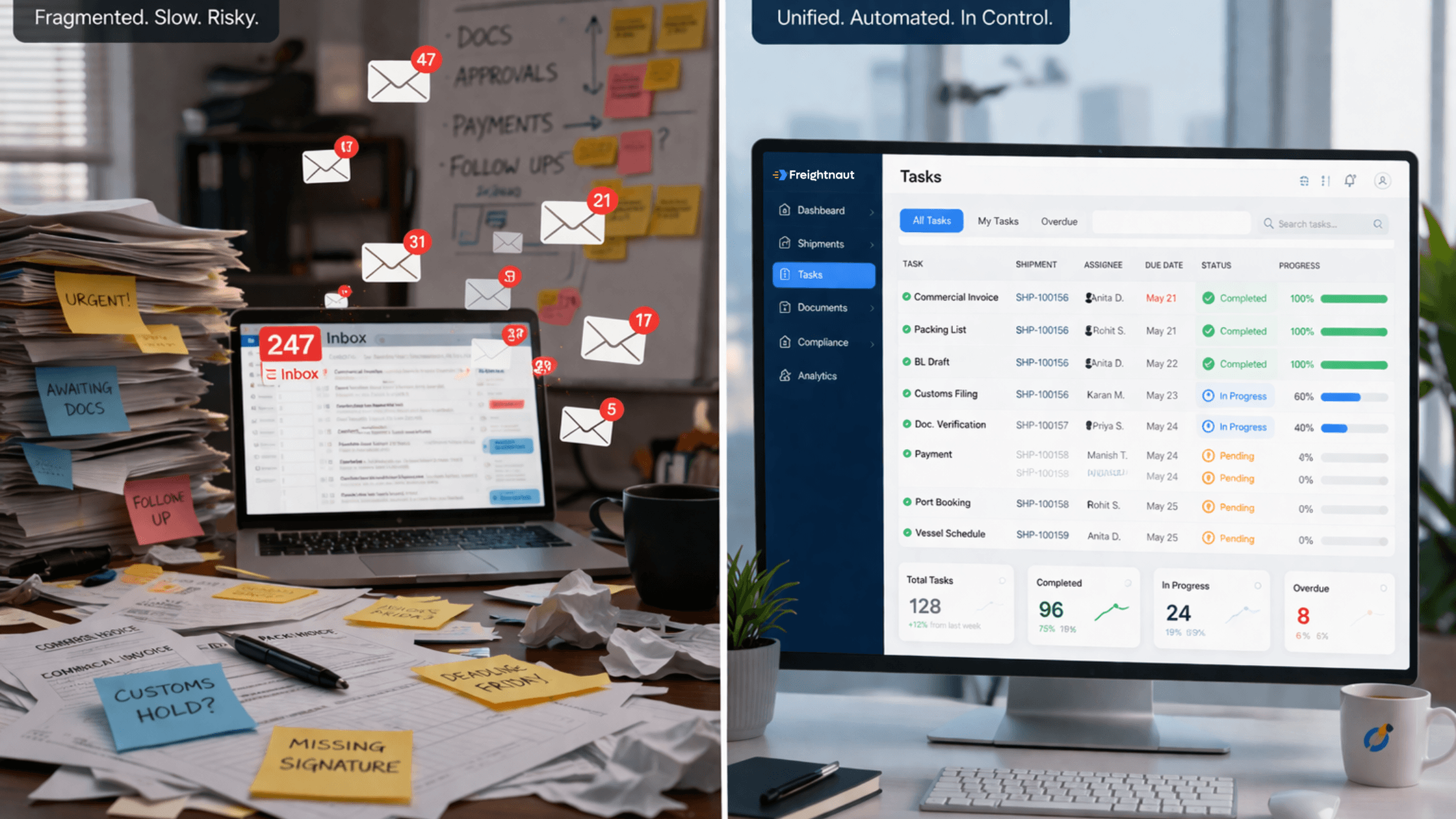
Implementing export documentation automation delivers measurable improvements across multiple dimensions of logistics operations. Let's examine the specific ways automation eliminates friction and creates competitive advantage.
Eliminate Communication Bottlenecks
Email chains create information silos and response delays. When a customs broker asks about shipment specifications, they shouldn't have to wait hours for someone to dig through their inbox. Centralized shipment tracking systems provide single-source-of-truth visibility where all stakeholders access the same real-time information.
Automatic notifications replace manual status updates. When the warehouse completes packing, the system instantly notifies the freight forwarder. When customs documentation is approved, the customs broker receives immediate confirmation. This stakeholder synchronization reduces cycle time by 30-40% compared to manual coordination.
Reduce Documentation Errors and Compliance Risks
Customs compliance automation applies validation rules that catch errors before they reach authorities. The system verifies that HS codes match product descriptions, checks that declared values align with invoices, and ensures all required certificates are attached before allowing document submission.
Document templates eliminate transcription errors. Instead of manually typing consignee addresses on bills of lading, commercial invoices, and packing lists, the system populates these fields from your master customer database. Changes made in one document automatically update related documents, maintaining consistency across your entire documentation package.
Audit trails track every document revision and approval, creating compliance evidence required for regulatory audits. You can instantly demonstrate who reviewed what document when, proving due diligence in your export control processes.
Accelerate Shipment Cycle Times
Manual processes force sequential task completion. One person finishes their work, then notifies the next person to start theirs. Logistics process optimization through automation enables parallel processing. While your logistics coordinator finalizes carrier booking, your compliance team simultaneously prepares customs documentation. These concurrent workflows compress overall cycle time.
Consider a typical export shipment that manually takes 5-7 business days from sales order to shipment departure. With automation, that timeline shrinks to 3-4 days because tasks start immediately without waiting for email responses, approvals happen faster through automated routing, and exceptions get flagged proactively rather than discovered late in the process.
Gain Real-Time Visibility and Control
Dashboard interfaces provide at-a-glance status across all active shipments. Managers quickly identify bottlenecks. Perhaps customs documentation consistently delays shipments to specific countries, indicating a training need. Exception management features highlight shipments at risk of missing deadlines, enabling proactive intervention.
Supply chain visibility extends beyond your four walls. Integration with freight forwarders and carriers pulls tracking updates automatically, showing real-time shipment location without requiring manual status inquiries. Customers receive proactive notifications when their shipments reach key milestones.
Scale Operations Without Adding Headcount
Here's the strategic advantage: Digital transformation in logistics through workflow automation decouples shipment volume from headcount requirements. The same team that manages 100 monthly shipments can handle 300 with automation because the system eliminates repetitive administrative work.
New team members become productive faster because workflows guide them through each process step. Institutional knowledge is codified in workflow templates rather than residing only in people's heads. When your experienced logistics coordinator takes vacation, operations continue smoothly because the system ensures nothing gets skipped.
Essential Features of Modern Logistics Workflow Automation
When evaluating freight forwarding workflow platforms, focus on capabilities that directly address your operational pain points. Not all systems are created equal. The right platform should offer these critical features:
Customizable workflow templates allow you to define unique processes for different shipment types, destinations, and product categories. Air freight to the EU requires different documentation than ocean freight to China. Your system should accommodate these variations without requiring IT intervention for every change.
Role-based task assignment automatically routes work to the appropriate team members based on shipment attributes and organizational structure. This ensures accountability while preventing task overlap and confusion about responsibility.
Document repository with version control maintains a complete, organized record of all shipment documentation. You should be able to instantly retrieve the final version of any document from any shipment, along with its revision history showing who made what changes when.
Approval routing and escalation rules streamline decision-making by automatically sending requests to the correct approvers based on shipment value, destination, or other criteria. If an approval sits idle beyond a defined timeframe, the system escalates to backup approvers, preventing bottlenecks.
Integration with freight forwarders and carriers eliminates double data entry and enables automated data exchange. When you book a shipment with your freight forwarder, that information should flow into your system automatically, triggering downstream workflows.
Real-time collaboration tools allow stakeholders to communicate within the context of specific shipments. Instead of separate email threads, comments and questions are attached directly to relevant tasks and documents, creating a complete conversation history accessible to all authorized users.
Compliance rule engines codify regulatory requirements and automatically apply them based on shipment characteristics. Export control screening, restricted party list checking, and documentation requirements should be enforced systematically, not relying on individual knowledge.
Analytics and reporting capabilities transform operational data into actionable insights. You should easily identify which lanes experience the most delays, which document types cause the most errors, and how your cycle times trend over time. These insights drive continuous improvement in your **export logistics management** .
Your Path to Automated Shipment Management
Implementing logistics workflow automation doesn't require a complete operational overhaul. Smart companies take an incremental approach that delivers quick wins while building toward comprehensive automation.
Map your current shipment workflows. Document every step in your existing process: who does what, when, and what triggers each action. Identify handoffs between teams and systems. This baseline assessment reveals where manual processes create delays and errors.
Identify repetitive tasks and bottlenecks. Which activities consume the most time? Where do shipments consistently get stuck? Common automation candidates include document generation, status update requests, approval routing, and compliance checks. Focus first on high-frequency, low-complexity tasks that deliver immediate time savings.
Define success metrics. How will you measure improvement? Consider metrics like average cycle time from order to shipment, documentation error rate, on-time shipment percentage, and staff time spent on administrative tasks versus value-added activities. Establish baseline measurements before implementation.
Start with high-volume, standardized shipment types. Your first automation initiative should target shipments with consistent patterns. Perhaps domestic LTL shipments or standard product exports to established markets. These predictable workflows allow you to refine your automation approach before tackling complex, variable shipments.
Gradually expand automation scope. After proving value with initial workflows, expand to additional shipment types and geographies. Each expansion builds on lessons learned, and your team's growing confidence with the platform accelerates adoption.
Change management deserves attention throughout this journey. Involve your team in workflow design. They understand the nuances of daily operations and will identify edge cases that need accommodation. Provide thorough training that goes beyond software features to explain the "why" behind new processes. Celebrate early wins to build momentum and stakeholder buy-in.
The Future of Shipment Management Is Automated
The transformation from scattered emails and spreadsheets to structured, intelligent workflows represents more than operational improvement. It's a strategic capability that enables growth. Logistics workflow automation gives you the operational leverage to serve more customers, enter new markets, and deliver superior service without proportionally increasing costs.
The technology that once required enterprise-level investment is now accessible to mid-market companies through cloud-based platforms. You don't need massive IT infrastructure or multi-year implementation timelines. Modern shipment management software can be operational in weeks, delivering measurable ROI within the first quarter.
As supply chains grow increasingly complex and customer expectations continue rising, the companies that thrive will be those that master operational excellence through intelligent automation. The question isn't whether to automate your logistics workflows. It's how quickly you can capture the competitive advantages automation provides.
Your shipments deserve better than chaos. They deserve clarity, control, and consistent execution. The tools to deliver that experience are available today. It's time to streamline freight forwarding operations and transform how your business manages the critical journey from order to delivery.