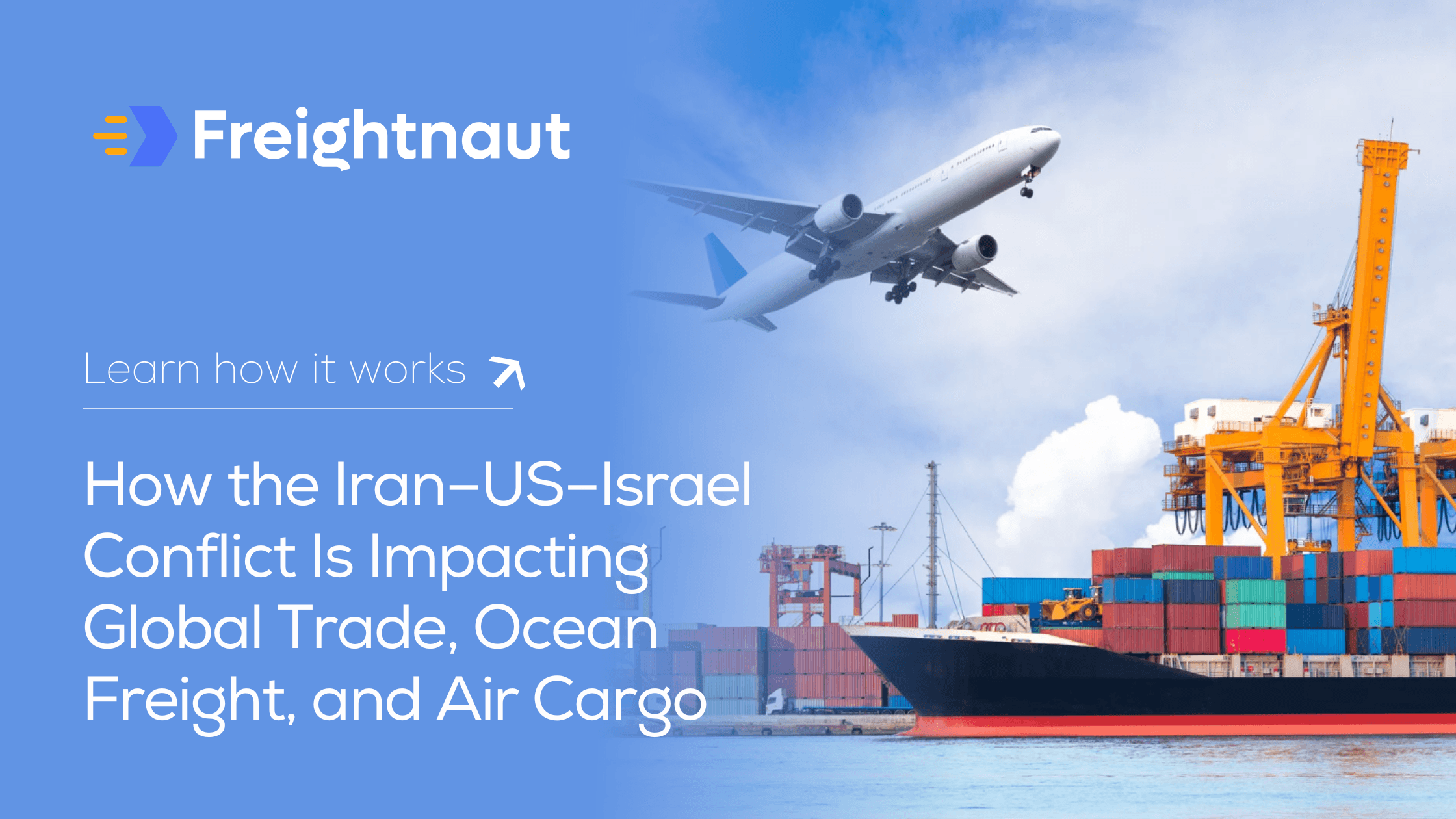
Global trade does not stop during conflicts, but it always absorbs the shock. The ongoing tensions between Iran, Israel, and the United States are no longer just geopolitical developments. They are actively influencing how goods move across oceans and skies, affecting freight costs, transit times, and supply chain reliability.
For logistics professionals and exporters, this is not distant news. It is already beginning to reflect in day-to-day operations.
The Strategic Importance of the Strait of Hormuz
One of the most immediate concerns is the Strait of Hormuz, a critical maritime chokepoint through which a significant portion of global energy supply flows. Any disruption or even perceived risk in this region directly impacts global shipping.
Increased risk leads to higher insurance premiums, route adjustments, and slower vessel movement. Even without a complete blockade, uncertainty alone is enough to influence freight markets and disrupt established trade flows.
Ocean Freight and the Rising Costs and Operational Disruptions
Ocean freight is often the first to reflect geopolitical instability. Shipping lines respond quickly to risk by introducing war risk surcharges, adjusting routes, and re-evaluating port calls.
This results in longer transit times, increased freight rates, and reduced schedule reliability. When vessels are rerouted or delayed, the ripple effects are felt across global supply chains, impacting inventory cycles and delivery commitments.
The current situation has the potential to create widespread disruptions, especially if tensions escalate further in key maritime regions.
Air Cargo and Rising Demand, Higher Costs
As uncertainty increases in ocean freight, businesses often shift to air cargo to maintain delivery timelines. However, this shift creates additional pressure on air logistics networks.
Airspace restrictions over conflict zones force airlines to take longer routes, increasing fuel consumption and operational costs. At the same time, rising fuel prices contribute to higher freight rates.
The result is a combination of increased costs, longer transit times, and limited capacity, making air cargo a more expensive but necessary alternative.
Exporters are Managing Uncertainty and Cost Pressure
For exporters, the impact is both operational and financial. Shipment delays can disrupt delivery commitments, while fluctuating freight costs directly affect pricing and margins.
Industries that rely on time-sensitive logistics, such as pharmaceuticals, perishables, and textiles, are particularly vulnerable. Uncertain transit timelines make planning difficult, forcing exporters to make quicker decisions with limited visibility.
The challenge is no longer just about moving goods, but about managing unpredictability.
The Real Challenge
While external disruptions cannot always be controlled, internal execution can.
In stable conditions, minor inefficiencies such as delayed approvals or missed documentation may go unnoticed. But in volatile environments, these small gaps quickly turn into significant delays.
A single missing document, an unclear task owner, or a delayed approval can hold back an entire shipment. As external uncertainty increases, the need for structured and efficient execution becomes critical.
The Shift Toward Execution-Focused Logistics
For years, logistics technology has focused on visibility. Tracking shipments and monitoring movement have been the primary focus.
However, visibility alone is no longer sufficient. Knowing where a shipment is does not ensure that it is ready to move. What matters equally is execution. Understanding what needs to be done next, who is responsible, and whether every step has been completed is becoming the real differentiator in logistics operations.
The Iran–US–Israel conflict highlights a larger truth about global trade. Supply chains are interconnected, and disruptions in one region can quickly ripple across the world. Freight costs can rise overnight, routes can change unexpectedly, and delays can compound rapidly. However, the way shipments are executed within organizations remains a controllable factor.
In times of uncertainty, the companies that operate with structured processes, clear ownership, and strong execution will be better positioned to adapt. Because while global trade may be unpredictable, execution does not have to be.