Every Indian exporter hits this question at some point usually at the worst possible time. Your shipment is ready. Your buyer is waiting. And someone asks: "Is this going on a Bill of Lading or an Airway Bill?"
If you've ever had to Google that in a hurry, you're not alone. The Bill of Lading (B/L) and Airway Bill (AWB) are two of the most important documents in international trade and two of the most confused. They look similar on paper, they serve overlapping purposes, but they are fundamentally different documents with very different legal implications.
Getting this wrong isn't just an embarrassment. It can hold your goods at the port, block your payment, and in some cases, let someone else walk away with your cargo.
This guide breaks it down completely what each document is, how they differ, when to use which one, and what Indian exporters specifically need to watch out for in 2026.
What Is a Bill of Lading (B/L)?
A Bill of Lading also written as B/L, BOL or sometimes "bill of laden" is a legal document issued by a shipping line (sea carrier) to the exporter once goods are loaded onto a vessel.
The simplest way to understand it: think of a Bill of Lading as three documents in one:
1. A Receipt — it confirms that the shipping line has received your goods, in the stated quantity and condition, for transport to the destination port.
2. A Contract of Carriage — it records the agreed terms between you (the shipper) and the carrier: the route, freight charges, vessel name, port of loading, port of discharge, and conditions of transport.
3. A Document of Title — this is what makes the B/L unique and powerful. It represents legal ownership of the goods. Your buyer cannot collect the goods at the destination port without presenting the original B/L. It can be transferred, endorsed, and traded making it a negotiable instrument in international trade finance.
That third function the document of title is what separates the Bill of Lading from almost every other shipping document, including the Airway Bill.
What Is an Airway Bill (AWB)?
An Airway Bill also written as AWB or Air Waybill is a document issued by an airline or air freight carrier to the exporter once goods are handed over for air transport.
Like the B/L, the AWB serves as:
A receipt confirming the airline has received your goods for shipment
A contract of carriage stating the terms of air transport
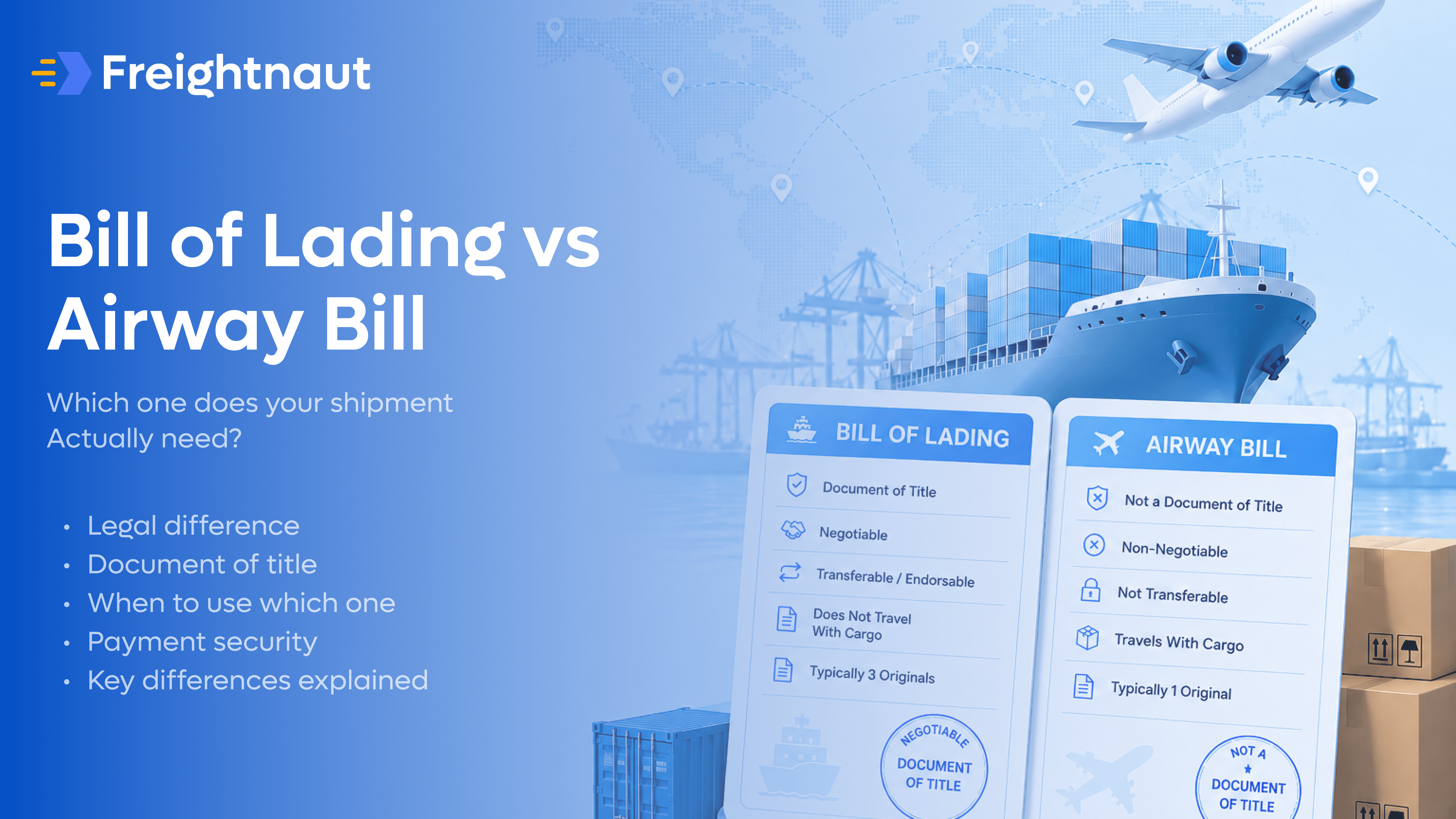
But here's the critical difference: an Airway Bill is NOT a document of title.
The AWB is non-negotiable. It cannot be transferred or traded. Your buyer does not need to present the original AWB to collect goods at the destination airport the airline releases cargo to the named consignee directly, based on identity verification. The original AWB actually travels with the cargo on the aircraft, unlike a B/L which is sent separately to the buyer.
This has major implications for payment more on that below.
Bill of Lading vs Airway Bill — The Key Differences at a Glance
Feature | Bill of Lading (B/L) | Airway Bill (AWB) |
|---|---|---|
Mode of Transport | Sea / Ocean Freight | Air Freight |
Issued By | Shipping Line | Airline / Air Carrier |
Document of Title? | Yes (negotiable) | No (non-negotiable) |
Consignee Can Be Changed? | Yes (endorsable) | No (fixed at issuance) |
Travels With Cargo? | No (sent separately) | Yes (travels with shipment) |
Transit Time | Slower (days to weeks) | Faster (hours to days) |
Used for LC Payments? | Commonly used | Can be used, with conditions |
Freight Cost | Lower | Higher |
Best For | Bulk, heavy, large volume cargo | High-value, time-sensitive, perishable cargo |
Originals Issued | Typically 3 originals | Typically 1 original (non-negotiable copy) |
The Biggest Difference: Document of Title
This is the concept most exporters get confused about so let's make it crystal clear.
When you ship goods by sea, your buyer needs the original Bill of Lading to take delivery at the destination port. Without it, the goods sit at the port. This makes the B/L a powerful payment security tool you control the B/L, you control when the buyer gets their goods.
This is why the Bill of Lading is central to Letter of Credit (LC) transactions. Under an LC, your bank holds the original B/L until the buyer's bank confirms payment. Only then is the B/L released to the buyer, who can then collect the goods. The sequence is: payment first, then document, then goods.
With an Airway Bill, this mechanism doesn't exist in the same way. Because the AWB is non-negotiable and the goods are released directly to the named consignee at the airport, your leverage over cargo release is limited. For LC transactions using air freight, banks work with specific AWB conditions but this requires careful coordination and is not as straightforward as sea freight LC documentation.
For Indian exporters selling on LC terms to new buyers: sea freight with a B/L gives you significantly stronger payment security than air freight with an AWB.
Types of Bills of Lading Indian Exporters Need to Know
Not all Bills of Lading are the same. Here are the main types you'll encounter:
1. Ocean Bill of Lading (OBL)
The standard B/L for sea freight — the one most Indian exporters deal with on every shipment. Issued by the shipping line once goods are loaded onto the vessel. This is what your CHA will handle through the shipping line's system.
2. House Bill of Lading (HBL)
Issued by your freight forwarder (not the shipping line directly) when your goods are part of a consolidated shipment i.e., your cargo is grouped with other exporters' cargo in one container (LCL — Less than Container Load). The freight forwarder issues you an HBL; the shipping line issues the freight forwarder a Master Bill of Lading (MBL).
Important: For LC transactions, most banks require the Master B/L (or a specific endorsement from the freight forwarder). Always check your LC terms carefully before accepting only an HBL.
3. Straight Bill of Lading
A non-transferable B/L where goods can only be delivered to the specific named consignee. Used for trusted buyer relationships where payment is already secured. Cannot be endorsed or transferred to a third party.
4. Order Bill of Lading
The most commonly used B/L in trade transactions. The consignee field is left as "To Order" making it transferable by endorsement. This is what your bank typically requires for LC documentation.
5. Surrendered Bill of Lading
When you surrender the original B/L at the port of loading, the shipping line sends an electronic release message to the destination port allowing your buyer to collect goods without presenting a physical original B/L. This is increasingly common for trusted buyer relationships with short transit times, like India to UAE or India to Sri Lanka.
6. Sea Waybill
Similar to a surrendered B/L — a non-negotiable sea transport document where goods are released to the named consignee without presenting an original. Used for trusted trade relationships. Not suitable for LC transactions.
Types of Airway Bills Indian Exporters Need to Know
1. Master Airway Bill (MAWB)
Issued by the airline to the freight forwarder when goods are consolidated. Covers the entire shipment from loading airport to destination airport.
2. House Airway Bill (HAWB)
Issued by the freight forwarder to the individual shipper/exporter. If you're using a freight forwarder to ship by air, the HAWB is what you'll receive. It contains your specific shipment details within the consolidated cargo.
When Should Indian Exporters Use a Bill of Lading?
Use a Bill of Lading when:
Shipping by sea — there's no choice here; sea freight requires a B/L
Payment is by Letter of Credit (LC) — the B/L is the key document of title that secures payment
Shipping large volumes or bulk cargo — machinery, steel, textiles in bulk, chemicals, heavy goods
Freight cost is a priority — sea freight is significantly cheaper per kg than air freight
Transit time flexibility exists — your buyer can wait 14–28 days (or longer post-Red Sea rerouting)
New buyer relationships — the B/L gives you stronger control over goods release until payment
When Should Indian Exporters Use an Airway Bill?
Use an Airway Bill when:
Shipping by air — AWB is mandatory for all air freight
Cargo is time-sensitive — pharmaceuticals, perishables, seasonal fashion, electronics
High-value, low-weight cargo — where air freight cost is justified by the value
Shipment needs to arrive quickly — 1–3 days transit vs. 14–28 days by sea
Payment is by advance (TT) — you've received payment before shipping, so cargo release control is less critical
Urgent orders or sample shipments — small quantities that must reach the buyer fast
Destination is landlocked — some markets are easier to reach by air
The LC Payment Question: Which Document Does Your Bank Need?
If your buyer is paying via Letter of Credit, the document requirements are usually very specific. A typical LC for sea freight will state:
"Full set of 3/3 original clean on-board ocean Bills of Lading made out to order of [Bank Name], notify [Buyer Name]..."
This means your bank needs all three originals of the B/L not a copy, not a House B/L from a freight forwarder, but the original ocean B/L from the shipping line.
For air freight LCs, the terms are different:
"Airway Bill consigned to [Bank Name] or [Buyer Name], showing freight prepaid..."
Because the AWB is non-negotiable, the bank cannot use it the same way it uses a B/L. Instead, the LC will typically require the AWB to be consigned to the buyer's bank giving the bank some control before releasing to the buyer.
Critical rule: Always read your LC terms carefully before booking your freight. If the LC says "ocean B/L" and you ship by air, the document you present to your bank will be rejected causing a discrepancy that delays your payment and may require a buyer amendment.
What Goes on a Bill of Lading? (Key Fields)
When your shipping line issues the draft B/L, verify every field carefully before approving the final version:
Shipper — your company name, address, IEC number
Consignee — your buyer's name (or "To Order" for negotiable B/L)
Notify Party — usually your buyer or their customs agent
Vessel Name & Voyage Number — must match your shipping bill
Port of Loading — must match your invoice and packing list
Port of Discharge — destination port
Description of Goods — must match your commercial invoice word-for-word
HS Code — must be identical across all documents
Gross Weight & CBM — must match packing list
Freight Terms — Freight Prepaid (you pay) or Freight Collect (buyer pays) must align with Incoterms
Number of Originals — typically 3
Never approve a B/L with errors. Amendments after issuance are possible but take time and can delay your payment if an LC is involved. Always review the draft B/L line by line against your commercial invoice.
What Goes on an Airway Bill? (Key Fields)
Shipper's Name and Address
Consignee's Name and Address — this is fixed at issuance; it cannot be changed later
Issuing Carrier's Name — airline
AWB Number — used for real-time air cargo tracking
Airport of Departure and Destination
Description of Goods
Number of Pieces, Gross Weight, Dimensions
Declared Value for Carriage and Customs
Freight Charges — prepaid or collect
The Real Cost Difference: Sea vs Air for Indian Exporters
One of the most common questions from first-time exporters: "Is the faster delivery worth the extra cost of air freight?"
Here's a realistic comparison for a typical 100 kg shipment from Mumbai to London in 2026:
Sea Freight (LCL) | Air Freight | |
Transit Time | 22–28 days (Cape routing) | 2–3 days |
Freight Cost (approx.) | ₹15,000–₹25,000 | ₹80,000–₹1,20,000 |
Document Used | Bill of Lading | Airway Bill |
Insurance Cost | Lower | Higher (shorter transit = less exposure) |
Best For | Textiles, engineering goods, bulk orders | Pharma, electronics, fashion samples, urgent orders |
For most Indian MSME exporters, sea freight with a B/L is the primary route and air freight with an AWB is reserved for emergencies, samples or high-value time-sensitive cargo.
The 2026 Factor: Real-Time Tracking on Both Documents
Whether you're using a B/L or an AWB, one thing has changed significantly in 2026: buyers expect real-time shipment visibility from the moment goods leave your factory.
An AWB number gives you instant air cargo tracking through the airline's system cargo arrives in 2–3 days and the AWB travels with it, so visibility is built in.
A B/L number allows container tracking through the shipping line's portal but with sea freight now taking 22–28 days via Cape routing, gaps in visibility between milestone events are a major issue. Buyers send enquiry after enquiry. Your team spends hours chasing freight forwarders for updates.
This is where a real-time shipment tracking platform like Freightnaut makes the biggest difference for sea freight exporters. Instead of manually checking the shipping line's portal every day, your shipment tracking dashboard aggregates live container tracking data showing exactly where your cargo is, whether there's a vessel change, and what the updated ETA is.
End-to-end shipment tracking from factory to foreign port means you and your buyer are always on the same page whether the document is a B/L or an AWB.
Quick Decision Guide: B/L or AWB?
Ask yourself these 3 questions:
1. How am I shipping?
By sea → Bill of Lading (no choice)
By air → Airway Bill (no choice)
2. How is my buyer paying?
Letter of Credit → need original B/L (sea) or specific AWB consignment (air)
Advance / TT → either works; payment is already done
3. What am I shipping?
Bulk, heavy, cost-sensitive → sea freight, B/L
Urgent, high-value, perishable → air freight, AWB
Common Mistakes Indian Exporters Make With These Documents
Mistake 1: Description mismatch between the B/L and invoice The goods description on your B/L must match your commercial invoice exactly. A difference triggers customs queries at the destination and LC discrepancies.
Mistake 2: Accepting only a House B/L for LC transactions If your LC requires an ocean B/L from the shipping line and your freight forwarder gives you only an HBL, your bank will reject the document. Always check LC requirements before booking with a forwarder.
Mistake 3: Not reviewing the draft B/L before approval Once the final B/L is issued, amendments require time, paperwork, and sometimes carrier fees. Review the draft carefully vessel name, port names, consignee details, HS codes, weight and freight terms.
Mistake 4: Assuming AWB works the same as B/L for LC payments They don't. If your LC specifies an ocean B/L and you switch to air freight last minute, your LC documents will be rejected. Always coordinate with your bank before changing the mode of transport.
Mistake 5: Not retaining originals Indian exporters must retain export documents including Bills of Lading for a minimum of 5 years for GST refund queries, RoDTEP audits, and trade disputes. Keep physical and digital copies of all originals.
How Freightnaut Helps With Shipping Documentation
Whether you're managing Bills of Lading for sea shipments or Airway Bills for air freight, the challenge is the same: keeping every document accurate, consistent and ready on time.
Freightnaut's export documentation software gives Indian exporters:
Custom export document templates built around your standard shipment details so every invoice, packing list, and shipping instruction is pre-populated correctly
Export document automation that ensures the description, HS code, and weight figures on your invoice match perfectly with what your CHA files on the Shipping Bill
Real-time shipment tracking dashboard that gives you live container location tracking for sea freight and air cargo tracking for air shipments from a single platform
Shipment visibility platform that keeps your buyer updated automatically no more manual status emails
All-in-one export management so your documentation and tracking live in one place, not scattered across email threads and carrier portals
When your B/L arrives with a draft error at 6pm and your vessel sails tomorrow morning, you don't want to be working from a spreadsheet. You want a system.
The Bottom Line
Bill of Lading = Sea freight. Document of title. Negotiable. Buyer needs original to collect goods.
Airway Bill = Air freight. NOT a document of title. Non-negotiable. Goods released directly to consignee.
Choose based on your mode of transport because that's the primary determinant. Then factor in your payment terms, cargo type, and transit time requirements.
Get the document right, and your shipment moves smoothly. Get it wrong, and your goods sit at a port while your buyer's patience runs out.
Ready to manage all your export shipping documents — B/L, AWB, invoices, packing lists — from one platform? Start your free trial with Freightnaut →
Tags: bill of lading, airway bill, bill of lading vs airway bill, what is bill of lading, what is airway bill, difference between bill of lading and airway bill, export documents list, import and export documentation, export documentation in shipping, shipping documentation software, export documentation software India, real-time shipment tracking, shipment tracking platform, container tracking system, live shipment visibility, shipment tracking dashboard, export document customization software, all-in-one export management platform, documents required for export, export documentation procedure, import export documentation